IndonesianTalk.com – The Indonesian Capital Market Professionals Association (PROPAMI) has urged market participants to respond to the turmoil that followed Morgan Stanley Capital International’s (MSCI) proposed change to Indonesia’s market classification in a proportionate, fact-based manner. The proposal triggered sharp selling in the Jakarta Composite Index (JCI). (18/10/26)
PROPAMI acknowledged that the JCI’s steep fall on 16 October 2026 was a serious event. But the association said the drop does not automatically mean the foundations of the national capital market have lost their investment appeal.
“Panic does not resolve structural problems, while ignoring those problems can prolong uncertainty,” PROPAMI said.
A Consultation, Not Yet a Decision
On 15 October 2026, MSCI launched a consultation on a proposal to reclassify Indonesia from Emerging Market to Standalone Market status, with a final decision to be announced no later than the end of June 2027. Indonesia’s status therefore has not changed automatically. The consultation gives stakeholders a chance to voice their views and gives authorities a chance to show evidence of reform progress.
PROPAMI cautioned that the process should not be taken lightly. MSCI has raised concerns over:
- ownership transparency;
- shareholding concentration;
- suspected coordinated trading; and
- whether there is sufficient evidence that reforms are producing sustainable change.
In PROPAMI’s view, these concerns must be answered with data, consistent policy implementation and credible enforcement. A defensive response without evidence will not restore investor confidence, it said, whereas openness about areas needing improvement can be the starting point for rebuilding credibility.
The JCI Is Not the Only Yardstick
PROPAMI argued that a one-day index move is not enough to draw conclusions about the health of the economy, individual listed companies or the long-term outlook for the market. Uncertainty over a global index classification can prompt investors who track that benchmark to rebalance their portfolios, and such adjustments can amplify price pressure, particularly in less liquid stocks.
The impact, it said, will not be uniform. Each issuer has a different financial position, business outlook, ownership structure, valuation and risk profile, so investors should avoid generalising across the market.
PROPAMI also noted that the potential capital outflows cited in media reports are estimates based on specific assumptions, not certainties. Actual flows will depend on MSCI’s final decision, investment mandates, the responses of active and passive investors, and market conditions when any change takes effect.
OJK and IDX Reforms Will Be Decisive
PROPAMI welcomed the commitment by the Financial Services Authority (OJK) to continue capital-market reforms and tighten enforcement. In a statement on 16 October 2026, OJK said it would follow up on MSCI’s feedback, strengthen market integrity and maintain communication with global index providers and institutional investors.
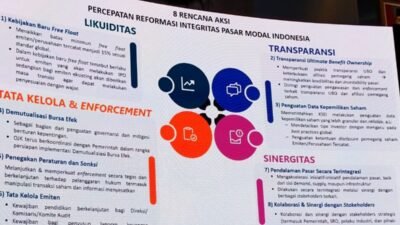
The reform initiatives announced include:
- disclosure of shareholdings above 1%;
- more granular investor classification;
- disclosure on High Shareholding Concentration (HSC); and
- a roadmap to raise the minimum free-float requirement.
PROPAMI called these measures a relevant foundation but stressed that reform will be judged by implementation and results. Investors need evidence that ownership data can be verified, that shares classified as free float are genuinely available for trading, and that suspected violations are addressed through consistent supervision and enforcement.
The association urged OJK, the Indonesia Stock Exchange (IDX), the Indonesian Central Securities Depository (KSEI) and other stakeholders to set clear milestones, measurable success indicators and progress updates the market can easily understand. It also described the IDX’s efforts to seek clarification from MSCI as important for pinpointing unresolved issues and aligning understanding on disclosure standards, measurement methodology and the evidence needed to assess progress.
Fundamentals Still Warrant Objective Assessment
OJK has said the domestic capital market retains prospects, supported by economic fundamentals, a growing investor base, competitive valuations and generally positive issuer performance. PROPAMI said this should be treated as a basis for evaluation, not a guarantee that share prices will rebound soon. Strong fundamentals do not automatically remove governance, liquidity, currency or global asset-allocation risks.
The association advised market participants to distinguish systemic risks from company-specific ones. Issuers with solid financial statements, healthy cash flow, sound governance and clear business prospects should be assessed on their own merits, without ignoring broader market risks. Transparency and integrity, it added, are required by all investors, not only foreign ones, including domestic investors who put their savings into the market.
Guidance for Investors and Industry
PROPAMI called on investors to base decisions on official information, fundamental analysis, liquidity conditions, investment horizons and individual risk tolerance, rather than headlines, rumours or unconfirmed estimates of capital flows. It also urged investors to review issuer disclosures, understand portfolio concentration risk, and avoid borrowing or using trading facilities beyond their financial capacity.
The association stressed that this does not mean investors should hold on to every position. What should be avoided, it said, are impulsive decisions made without understanding one’s own position and the information available.
For industry players, PROPAMI asked securities firms, investment managers, analysts and other professionals to explain risks transparently, refrain from spreading unverified information, and put clients’ interests first in line with applicable rules.
A Chance to Rebuild Confidence
PROPAMI said restoring confidence will require joint effort from regulators, market operators, issuers, securities firms, institutional investors and professional associations. Regulators should keep enforcement and disclosure consistent. The exchange and supporting institutions should improve data quality and surveillance. Issuers should enhance transparency and governance. PROPAMI itself said it is ready to promote professional competence and ethics and to contribute to responsible market education.
“Confidence is not built by denying problems, but by demonstrating that each problem is addressed seriously, fairly and measurably,” the association said.
PROPAMI concluded that Indonesia’s capital market still has significant work ahead, but that MSCI’s consultation is ongoing and the opportunity to demonstrate verifiable progress remains open. Its message to the market: stay calm, stay critical and stay rational. Do not ignore risks, but do not treat a single market event as a verdict on the market’s entire future.