IndonesianTalk.com — THE SUFI BANK ACCOUNT
- By Asri Hadi
Treasurer, Indonesian Digital Media Association (AMDI)
There are people who wake up every morning, open their eyes — and then open their bank accounts.
Sometimes, the order is reversed.
The bank account comes first. Only after checking the balance do their eyes truly open.
They look at the numbers. They check what has come in and what has gone out. If the balance has increased, their spirits rise with it. If it has fallen, even the morning coffee somehow tastes less sweet.
Such is the peculiar power of money.
In reality, money is largely a number. Yet we often give that number extraordinary authority over our emotions.
The Sufis might smile at the way we behave. Not because they despise money. Nor because a Sufi must necessarily be poor, dress in worn-out clothes, live austerely and withdraw from worldly life.
Sufism is not quite that simple.
What must be kept at a distance is not money.
It is attachment.
There is a simple saying that captures the Sufi relationship with wealth: Money may remain in your hand, but never let it settle in your heart.
Easy to write.
Much harder to live by.
Modern life, in fact, often teaches us precisely the opposite. Money may not always be in our hands, but it is almost constantly on our minds.
We wake up thinking about mortgage payments and bills. We go to work pursuing income. During the day, we calculate earnings. At night, we think about investments. Sometimes, even during prayer, worldly calculations somehow find their way into our thoughts.
So perhaps the real question is not how much money we possess.
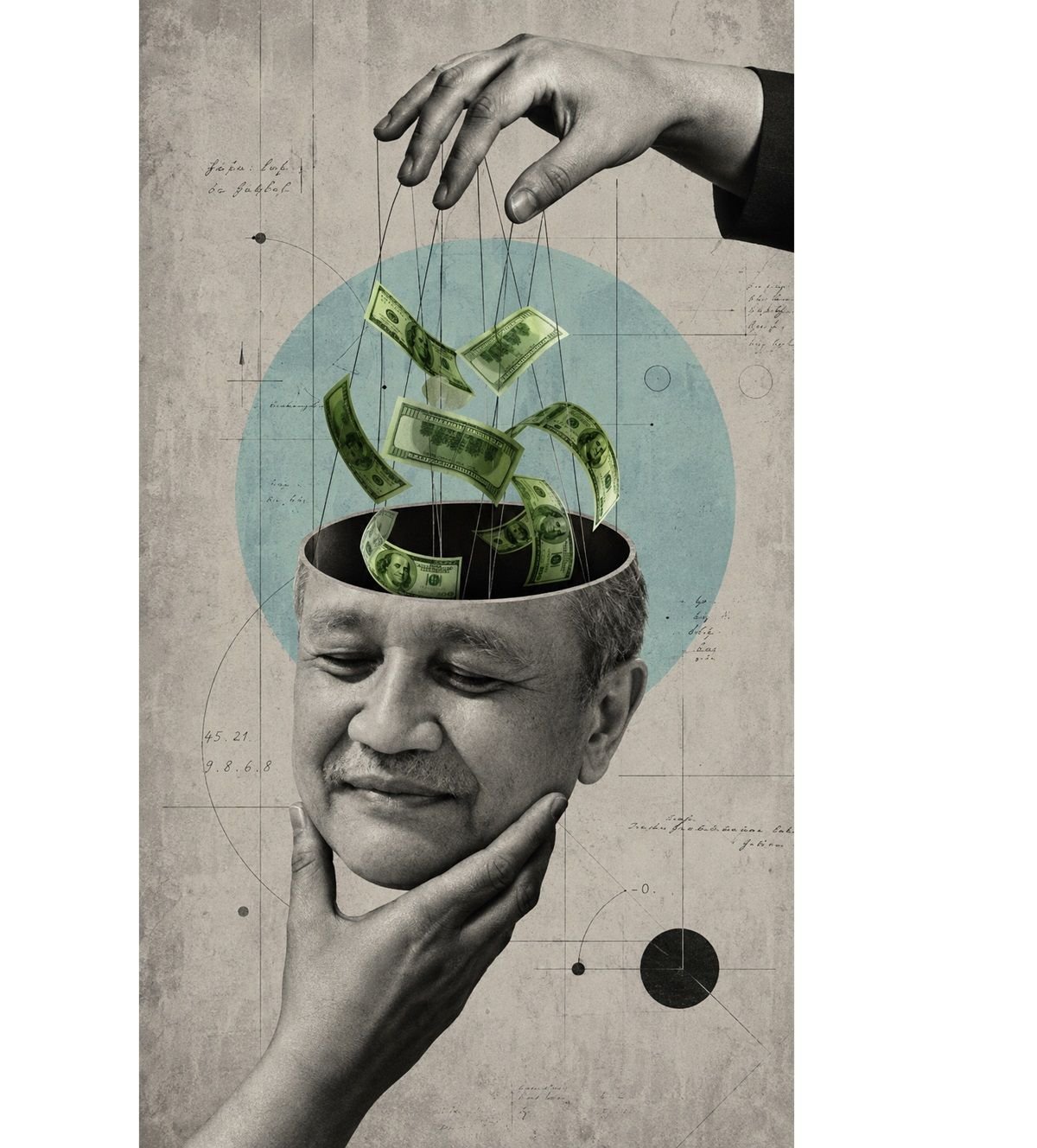
It is how much money possesses us.
A person with Rp 10 billion in the bank is not necessarily enslaved by wealth. Someone with Rp 10 million, meanwhile, may spend an entire life terrified of losing it.
This is where Sufism offers an intriguing perspective.
In the tradition associated with Imam Al-Ghazali, money is essentially a medium of exchange. It allows people to establish value and conduct transactions. Money makes economic life possible and practical.
It is a tool.
It was never meant to become life’s ultimate destination.
The trouble begins when the tool is promoted into a purpose.
We then cease working so that we can live and begin living so that we can continue accumulating.
The house that is already comfortable must become bigger. The perfectly good car must be replaced. The healthy bank balance must grow larger. Once one financial milestone is reached, another immediately appears on the horizon.
There is no finish line.
Perhaps that is one of wealth’s great paradoxes.
The poor fear having no money.
The rich sometimes fear losing what they have.
Both can lose sleep.
Sufism offers a different kind of freedom: the ability to feel that one has enough without abandoning the desire to work and progress.
That distinction matters.
Qanaah, or contentment, is not laziness. Zuhud, or detachment from worldly possessions, is not hostility toward wealth. Tawakal, or trust in God, is certainly not an excuse to stop working.
A merchant continues trading. An entrepreneur continues seeking profits. A professional continues pursuing excellence. An investor continues calculating risks.
What changes is the inner relationship with the outcome.
Profit does not convince a person that he is suddenly superior to everyone else. Loss does not persuade him that the world has ended.
The bank balance may rise and fall.
The heart should not become another financial chart.
I sometimes imagine that if the Sufis had mobile banking apps, they might demand one additional feature unavailable from any bank today: a heart balance.
There would be no deposits, stocks, bonds, gold, houses or vehicles listed there.
Instead, the statement might record something entirely different: how much we have given to others; how many obligations to others we have fulfilled; how much of our livelihood was earned honestly; and how much gratitude remains after our needs have been satisfied.
An ordinary bank records money coming in and money going out.
A Sufi account would record something else.
Where did the money come from?
And where did it go?
Two people may each possess Rp 1 billion. Yet the spiritual value of those two fortunes could be completely different.
One may have accumulated it through deception, bribery, manipulation or by taking what rightfully belonged to others. The other may have earned the same amount through hard work, honest trade, creativity and the courage to take risks.
The numbers are identical.
The value is not.
The same principle applies when money leaves our hands.
Rp 100,000 spent merely to impress others carries a different meaning from Rp 100,000 quietly given to someone struggling to make ends meet.
The denomination is identical.
But in the ledger of life, they are entirely different transactions.
That is why the Sufi does not merely ask: “How much do I have?”
He asks another question: “What is my wealth doing to my heart?”
Does having more money make us calmer, or increasingly frightened of losing it?
Does becoming wealthier make generosity easier, or letting go more difficult?
Does wealth make us freer, or does it simply create new chains?
That final question deserves particular attention.
We often assume that wealth means freedom. Yet wealth itself can become a prison when an entire life is consumed by the effort to protect it.
The house must be secured. Investments must be monitored. Businesses must be defended. Positions must be preserved. Networks must be maintained.
As possessions multiply, anxieties sometimes multiply with them.
True wealth, from a spiritual perspective, therefore cannot simply mean the ability to own many things.
It is also the ability not to be owned by the things we own.
That is the Sufi bank account.
It is not necessarily an account with little money in it. Its balance could be enormous. It could also be modest.
That is beside the point.
What matters is that the account holder remains the owner.
Money works for the person, rather than the person becoming a servant of money.
There is nothing inherently wrong with enjoying a comfortable home, a good car, delicious food or pleasant journeys.
Sufism need not turn human beings into enemies of worldly enjoyment. It merely asks us to remember that everything we enjoy is temporary.
Today, the ownership certificate carries our name.
Tomorrow, perhaps it will not.
Eventually, even the largest bank account will be left behind.
No one takes an ATM card into the grave.
There is no EDC terminal in the hereafter.
What remains is the trail left by how that money was earned and how it was spent.
Perhaps, then, there is a question more important than the balance displayed on our banking app tonight:
If all that money suddenly disappeared, would we still know who we are?
If the answer is yes, perhaps we have begun to understand the meaning of the Sufi bank account.