IndonesianTalk.com –– Understanding SWIFT Codes, BICs and IBANs: A Complete Guide to International Bank Transfers in Indonesia
JAKARTA — As cross-border digital transactions become increasingly common, more Indonesians are encountering terms such as SWIFT Code, BIC, and IBAN.
Whether receiving a salary from overseas, collecting payments from global digital platforms, paying tuition abroad, or conducting international business, understanding these banking identifiers has become essential.
Although the three terms are often used interchangeably, they serve different purposes within the global financial system. Knowing the distinction can help customers avoid costly delays and failed international transfers.
What is a SWIFT Code?
A SWIFT Code is a unique identification code assigned to banks participating in the international payment network operated by the Society for Worldwide Interbank Financial Telecommunication (SWIFT).
When money is transferred across borders, the SWIFT Code tells the global banking network exactly which financial institution should receive the funds.
A standard SWIFT Code consists of 8 to 11 characters.
For example:
BMRIIDJA
This code can be broken down as follows:
BMRI – Bank Mandiri
ID – Indonesia
JA – Jakarta
Additional three characters (if applicable) identify a specific branch.
Without the correct SWIFT Code, an international payment may be delayed, rejected, or routed incorrectly.
What is a BIC?
BIC, or Bank Identifier Code, is essentially the same as a SWIFT Code.
The distinction lies mainly in terminology.
SWIFT refers to the international financial messaging network.
BIC is the official ISO standard name for the bank identification code.
In practice, if an international transfer form requests a BIC, customers should simply provide their bank’s SWIFT Code.
What is an IBAN?
Unlike a SWIFT Code, which identifies a bank, an International Bank Account Number (IBAN) identifies an individual customer’s bank account in participating countries.
An IBAN may contain up to 34 alphanumeric characters, including:
country code;
check digits;
bank identifier;
account number.
A typical example is:
DE89 3704 0044 0532 0130 00
This IBAN belongs to a bank account in Germany.
The standardized format minimizes errors and allows automated processing of international transfers throughout Europe and many other regions.
Does Indonesia Use IBAN?
The answer is no.
Indonesia has not adopted the IBAN system.
As a result, individuals receiving international transfers into Indonesian bank accounts are generally required to provide only:
recipient’s full name;
bank account number;
bank name;
bank address (when requested);
SWIFT Code (or BIC).
If an overseas transfer form includes an IBAN field, Indonesian customers can usually leave it blank if the payment system allows.
Common SWIFT Codes for Major Indonesian Banks
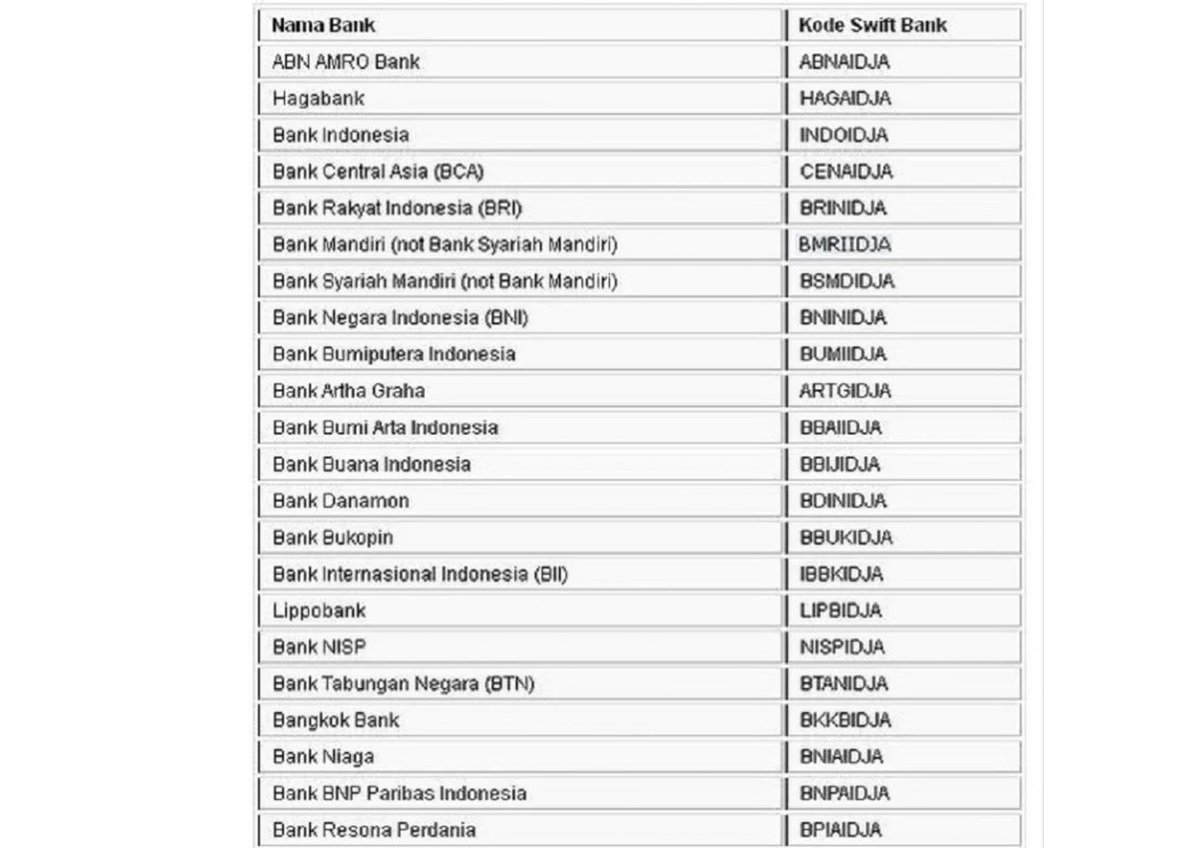
The following SWIFT/BIC Codes are commonly used for international transfers involving Indonesian banks.
Bank SWIFT / BIC Code
Bank Mandiri BMRIIDJA
Bank Central Asia (BCA) CENAIDJA
Bank Negara Indonesia (BNI) BNINIDJA
Bank Rakyat Indonesia (BRI) BRINIDJA
CIMB Niaga BNIAIDJA
Bank Danamon BDINIDJA
PermataBank BBBAIDJA
Panin Bank PINBIDJA
OCBC Indonesia NISPIDJA
Maybank Indonesia IBBKIDJA
Bank Mega MEGAIDJA
Bank Sinarmas SBJKIDJA
Bank Tabungan Negara (BTN) BTANIDJA
Bank DKI BPDKIDJA
Bank Jatim PDJTIDJA
Bank BJB PDJBIDJA
Bank DIY PDYOIDJA
Bank Sumut BDMUIDJA
Bank Nagari PDWGIDJA
Bank Kaltimtara* BPDKIDJX
Some regional development banks may use different SWIFT Codes for their head office or specific branches. Customers are advised to confirm the correct code directly with their bank before initiating an international transfer.
When is a SWIFT Code Required?
A SWIFT Code is commonly required when:
receiving a salary from an overseas employer;
receiving payments from Google AdSense, YouTube, Amazon, or other international companies;
export and import transactions;
sending money abroad;
paying tuition fees to foreign universities;
making international investments;
receiving remittances from Indonesian migrant workers overseas.
How to Find Your Bank’s SWIFT Code
Customers can obtain their bank’s SWIFT Code through several official channels:
the bank’s official website;
customer service hotline;
local branch offices;
passbooks or internet banking services (available at some banks).
Before completing any international transfer, customers should verify that the SWIFT Code matches the receiving bank to avoid processing delays.
Common Mistakes in International Transfers
Banking experts note that many international payment problems stem from simple administrative errors.
The most common mistakes include:
confusing an account number with an IBAN;
entering the wrong SWIFT Code;
using an incorrect branch code;
providing a recipient name that does not exactly match the bank account;
selecting the wrong destination country.
Even minor inaccuracies may cause payments to be delayed, returned to the sender, or subject to additional correspondent banking fees.
Understanding the Difference Matters
Although SWIFT Code and BIC refer to the same bank identification standard, IBAN serves a completely different purpose by identifying individual bank accounts in countries that have adopted the system.
Since Indonesia does not currently use IBAN, most international transfers into Indonesian bank accounts require only the recipient’s name, account number, bank name, and SWIFT Code.
As international commerce, freelancing, digital content creation, and overseas employment continue to expand, financial literacy surrounding global payment systems has become increasingly important.
Understanding the differences between SWIFT Codes, BICs, and IBANs can help individuals and businesses complete cross-border transactions more efficiently while reducing the risk of costly payment errors.