IndonesianTalk.com — Government Communication Must Overcome Information Barriers
- By Dr. Eko Wahyuanto
Indonesia’s national priority programs are under intense public scrutiny. Civil society groups, academics and citizens closely monitor initiatives that involve substantial state spending and directly affect millions of people, including the Free Nutritious Meals (MBG) program, the Red-and-White Village and Urban Cooperative (KDMP) initiative, and the People’s School program.
In such an environment, the success of public policy depends not only on effective implementation but also on the government’s ability to manage information in an open, accurate and consistent manner.
The MBG program provides a compelling example. As one of President Prabowo Subianto’s flagship initiatives, it aims to improve the quality of Indonesia’s human resources through better nutrition for schoolchildren.
In the long term, the program is expected to strengthen human capital development while contributing to national food security.
Like any large-scale public policy, however, MBG faces challenges. Beyond operational and governance issues, there is another risk that deserves equal attention: communication barriers, misinformation and the emergence of narratives that are not entirely grounded in facts.
In the digital era, information often travels faster than clarification. Social media has become a primary source of news and information for many citizens, while platform algorithms frequently create echo chambers where users are exposed mainly to information that reinforces their existing beliefs.
In such circumstances, incomplete or misleading information can quickly evolve into a dominant public perception that becomes difficult to correct.
The challenge for government communication today is therefore no longer simply about disseminating information. It is about ensuring that information reaching the public is credible, contextual and understandable.
Calibrating Communication Accountability
The government’s ongoing efforts to improve governance within the MBG program—from infrastructure validation and supply chain strengthening to enhanced oversight mechanisms—must be accompanied by equally robust public communication.
This is where the role of the Republic of Indonesia Government Communication Agency (Bakom RI) becomes increasingly significant.
Government communication should not be viewed merely as a tool for image-building. Its primary function is to bridge the public’s need for reliable information while ensuring that policies are understood in their entirety.
Effective communication must begin with verified data from credible sources. Monitoring program implementation through Nutrition Fulfillment Service Units (SPPG) across the country is important not only for operational purposes but also as a source of factual information that can explain policy developments to the public.
Such an approach helps reduce the gap between realities on the ground and public perception. When citizens receive information supported by data, there is less room for speculation and confusion.
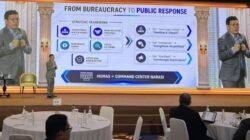
Bakom RI head Muhammad Qodari has emphasized the importance of information standardization through a one-gate policy. Under this approach, weekly press briefings would serve as a centralized platform for communicating developments related to priority government programs and strategic issues.
The objective is straightforward: to ensure that ministries and government agencies deliver consistent messages and provide a single point of reference for public information. This reduces the risk of conflicting narratives that can confuse the public and undermine trust.
The initiative represents an important breakthrough in addressing communication barriers. When the public receives consistent information from institutions representing the government, confidence in official communication is strengthened.
Communication as Risk Mitigation
For a program as complex as MBG, communication must go beyond public relations.
The initiative involves multiple ministries and agencies and depends heavily on cooperation among regional governments, businesses, farmers, livestock producers, cooperatives and nutrition service providers across Indonesia.
In this context, communication should be understood as an integral component of policy risk mitigation.
Food distribution in disadvantaged, frontier and outermost regions, for example, presents logistical challenges that differ significantly from those faced in urban centers. Delays or operational disruptions that are not explained transparently can quickly generate negative perceptions about the program as a whole.
Effective communication should therefore explain not only achievements but also challenges and the measures being taken to address them. Transparency of this kind is not a liability; it is a critical asset in building public trust.
The same principle applies to partnerships. Clear and accessible information regarding cooperation mechanisms with farmers, cooperatives and local businesses helps create certainty for stakeholders while reducing opportunities for misinformation to spread.
Countering Echo Chambers and Disinformation
One of the greatest challenges in today’s information environment is the growing influence of digital conversations shaped more by emotion than by facts.
To navigate this landscape, the government must prioritize communication that is transparent, honest, timely and empathetic. Delayed responses often allow speculation and misinformation to fill the information vacuum.
Bakom RI should position itself as a producer and distributor of high-quality information capable of filling gaps left by fragmented information flows. When communication disruptions occur or issues emerge that could trigger public controversy, speed alone is not enough. Policymakers must also understand the potential ripple effects of their responses.
The guiding principle is simple: accurate information must reach the public before rumors do. Information vacuums should never be left unaddressed, as they are quickly occupied by speculation and content designed primarily to satisfy digital algorithms rather than inform the public.
For this reason, a one-gate policy, stronger interagency coordination, regular engagement with the media and the production of educational digital content should become key elements of an integrated communication strategy.
The goal is not to control public opinion. Rather, it is to ensure that citizens have access to complete, accurate and accountable information.
Building Public Trust
Ultimately, the effectiveness of government communication should not be measured by the volume of information produced but by the level of trust it generates.
Communication strategies grounded in data, transparency and message consistency are far more effective in fostering constructive public engagement than reactive responses to controversy.
Clear and precise narratives are essential to preventing communication barriers and supporting the success of strategic national programs such as MBG, People’s Schools and the KDMP initiative.
When governments openly explain the objectives, processes, challenges and achievements of public programs, citizens are better equipped to evaluate policies objectively.
This is why cooperation among the National Nutrition Agency, Bakom RI, regional governments, the mass media and other stakeholders must continue to be strengthened.
Healthy public communication is more than a mechanism for delivering information. It is an instrument for building trust, encouraging civic participation and ensuring that public policies are implemented with strong legitimacy.
In an era defined by an overwhelming flow of digital information, communication vacuums cannot be allowed to persist. Spaces not filled with credible information are easily occupied by irresponsible actors and narratives that distract the public from the substance of policy itself.

- Dr. Eko Wahyuanto is a Senior Expert at the Republic of Indonesia Government Communication Agency (Bakom RI).