IndonesianTalk.com — ARUN Urges Strong Asset Recovery Bill, Warns Against Violations of Citizens’ Rights
JAKARTA – The National People’s Advocacy Council (DPP ARUN) has called on lawmakers to ensure that the proposed Asset Forfeiture Bill provides law enforcement agencies with effective tools to recover proceeds of crime while safeguarding citizens’ constitutional and property rights.
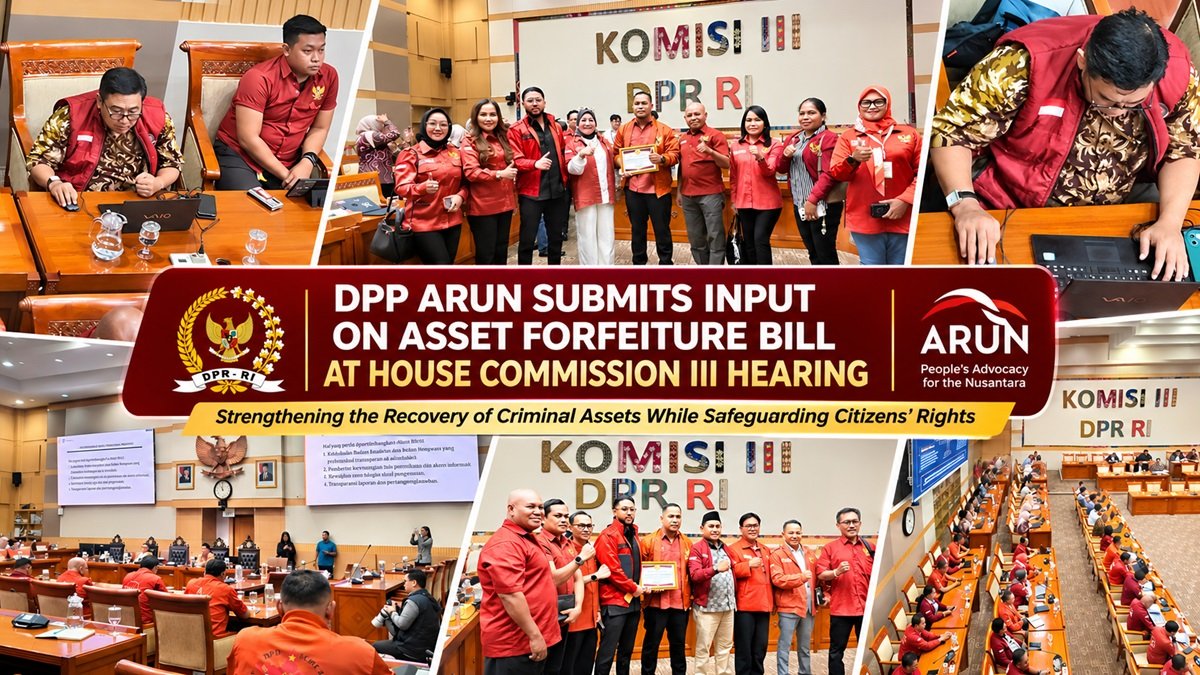
The organization delivered its recommendations during a public hearing with House of Representatives Commission III on Wednesday, Nov. 11, 2026, as part of the ongoing deliberations on the Draft Law on Asset Forfeiture Related to Criminal Offenses.
DPP ARUN said its participation reflected a commitment to meaningful public involvement in the legislative process, particularly in developing stronger legal instruments to combat corruption, financial crimes and other offenses that generate illicit wealth.
The hearing was attended by members of DPP ARUN’s national leadership, including chairpersons, secretaries and treasurers representing various regions across Indonesia.
Also present was Wim Tohari Danealdi, an international relations academic at Universitas Komputer Indonesia, researcher at the Center for Maritime Security and Water Resilience Studies, and participant in the MagangHub BKD program representing the Legal Drafters Forum for Safeguarding the Asset Forfeiture Bill.
Beyond criminal convictions
DPP ARUN argued that efforts to combat crime should not end with the prosecution and imprisonment of offenders. The state must also be capable of tracing, seizing, confiscating and recovering assets derived from criminal activities.
One of the persistent challenges in law enforcement, the organization noted, is the ability of perpetrators to conceal or transfer illicit proceeds through shell companies, third-party bank accounts, layered transactions, property ownership structures and cross-border financial networks.
For this reason, the principles of follow the money and asset recovery should form the foundation of the proposed legislation.
The organization said an effective legal framework was necessary to prevent criminals from continuing to benefit from their unlawful gains, while creating opportunities to recover state losses and restore the rights of victims.
“Fighting crime must go beyond punishing the perpetrators. The state must also be able to trace and recover the proceeds of crime,” DPP ARUN said in outlining its position.
“It would be unacceptable if perpetrators were sent to prison while the wealth obtained through illegal activities continued to benefit those involved.”
Five safeguards against abuse
While supporting stronger asset recovery powers, DPP ARUN cautioned that asset confiscation represents an extensive exercise of state authority that directly affects citizens’ property rights.
The organization therefore stressed the importance of legal certainty, due process, transparency and effective oversight.
It outlined five principles that should be incorporated into the bill.
First, the legislation must clearly define the categories and scope of assets subject to confiscation to prevent ambiguity and arbitrary interpretation.
Second, the evidentiary requirements must be legally valid and accountable. The connection between an asset and an alleged criminal offense must be subject to clear judicial procedures and fair legal scrutiny.
Third, asset owners must be given adequate opportunities to challenge confiscation decisions and establish their legitimate ownership rights.
Fourth, the rights of bona fide third parties must be protected. Members of the public who have no involvement in criminal activities should not become collateral victims of enforcement actions.
Fifth, the recovery of victims’ assets and state losses must be prioritized through transparent, measurable procedures and clearly defined implementation mechanisms.
DPP ARUN said these safeguards were essential to ensure that the bill became an effective instrument against crime without undermining constitutional protections or the principles of the rule of law.
Independent oversight needed for seized assets
Beyond the confiscation process itself, DPP ARUN also raised concerns about how seized and forfeited assets would be managed once they came under state control.
The success of asset recovery, it argued, should not be measured solely by the total value of assets confiscated. The government must also ensure that those assets are professionally managed, transparently administered and protected against depreciation or misuse.
Confiscated assets can include cash, land, buildings, vehicles, shares, companies and other economic instruments. Without a sound management system, such assets could lose their value, remain idle or become vulnerable to abuse of authority.
To address this risk, DPP ARUN highlighted the importance of establishing an independent oversight mechanism, including its proposal for a dedicated five-member Supervisory Council.
The proposed body would oversee governance, transparency, accountability and reporting in the management of seized and forfeited assets.
Such supervision, the organization said, should cover the entire process, from the initial seizure to the eventual transfer of assets to the state or their rightful owners.
“Assets confiscated from criminals must not become an opportunity for new forms of abuse. Transparency and oversight must be built into the system from the outset,” DPP ARUN emphasized.
Quality legislation must take precedence over deadlines
DPP ARUN also took note of the proposed legislative target of completing deliberations on the bill and securing its passage no later than Dec. 15, 2026.
The organization expressed support for efforts by the House and the government to accelerate the legislation. However, it warned that speed should not come at the expense of substantive quality, public participation or careful legal drafting.
A law that grants extensive powers to the state, it argued, must emerge from an open, inclusive and accountable legislative process.
The participation of civil society organizations, academics, legal practitioners and other public-interest groups should therefore continue throughout the deliberations.
For DPP ARUN, public participation should not be treated as a procedural formality. Rather, it is an essential mechanism for ensuring that legislation addresses public needs and does not create new legal uncertainties.
Firm against crime, fair to the people
Following the public hearing, DPP ARUN reaffirmed its commitment to monitoring the bill’s progress and contributing to its further development.
The organization said it fully supported efforts to establish effective legal instruments to pursue criminal proceeds, combat corruption, recover state losses and restore the rights of affected communities.
However, it stressed that a state governed by the rule of law must be strong not only in exercising its authority but also in ensuring accountability and protecting the legitimate rights of its citizens.
DPP ARUN expressed hope that its recommendations would be taken into consideration by Commission III as lawmakers refine the bill’s provisions.
Its position is straightforward: the state must have the courage and capacity to confiscate assets derived from crime, but it must never take away the legitimate property rights of ordinary citizens.
The proposed Asset Forfeiture Law, it concluded, should become a legal weapon against crime, not a new source of legal uncertainty.


- DPP ARUN – Safeguarding Justice, Defending the People’s Interests and Protecting Indonesia.