IndonesianTalk.com — Minangkabau Figures Who Changed Indonesia: Leadership Lessons Across Generations
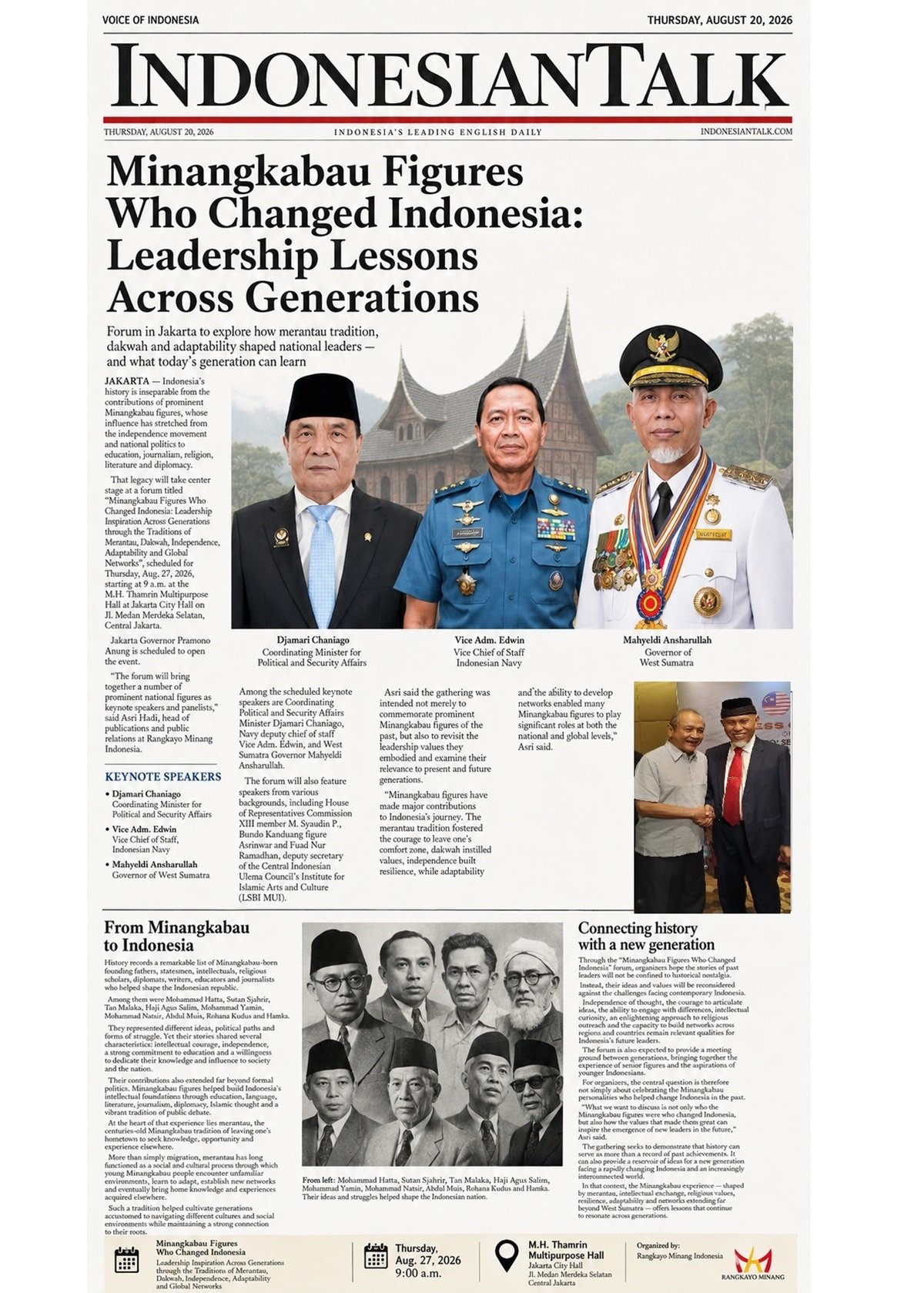
JAKARTA — Indonesia’s history is inseparable from the contributions of prominent Minangkabau figures, whose influence has stretched from the independence movement and national politics to education, journalism, religion, literature and diplomacy.
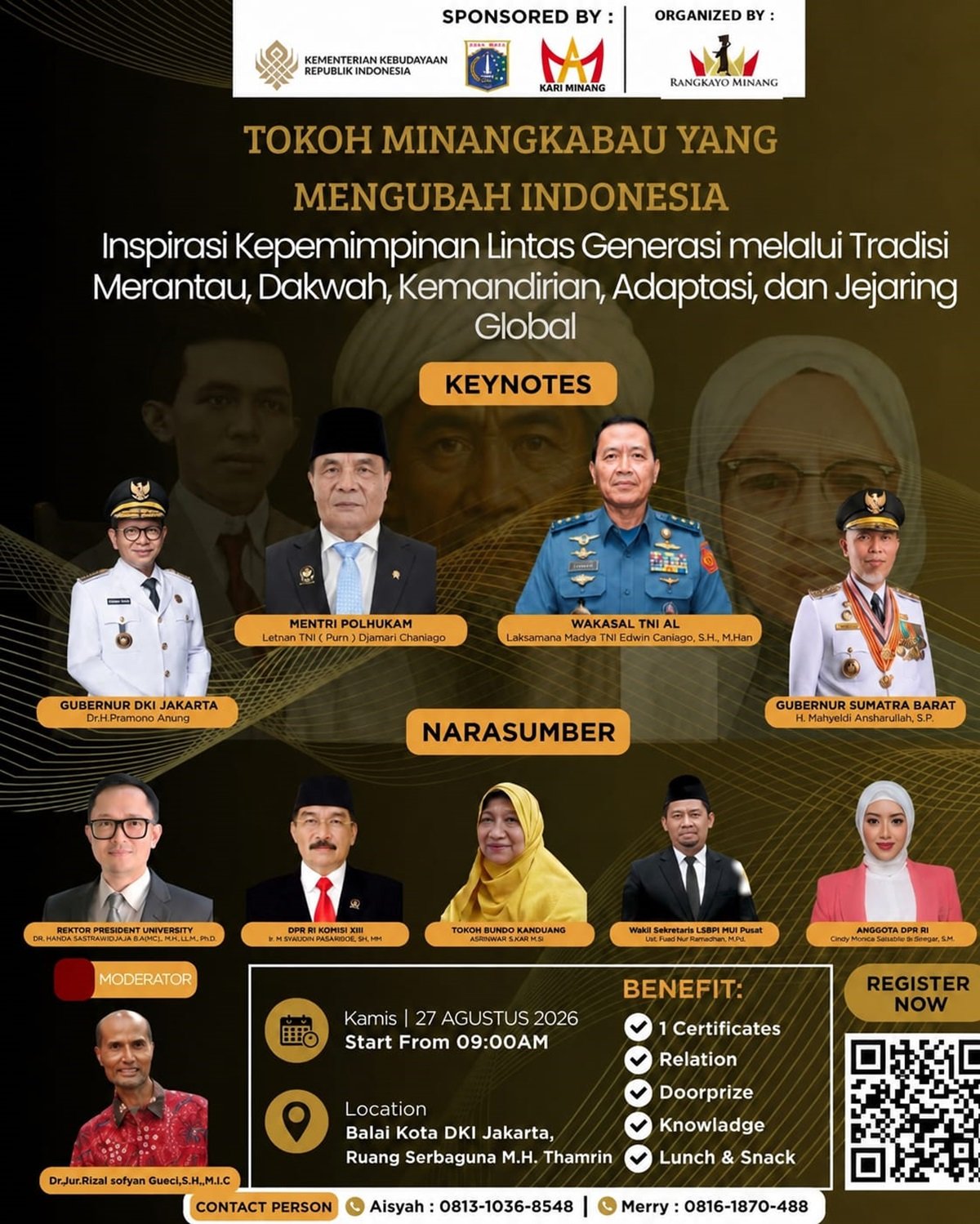
That legacy will take center stage at a forum titled “Minangkabau Figures Who Changed Indonesia: Leadership Inspiration Across Generations through the Traditions of Merantau, Dakwah, Independence, Adaptability and Global Networks”, scheduled for Thursday, Aug. 27, 2026, starting at 9 a.m. at the M.H. Thamrin Multipurpose Hall at Jakarta City Hall on Jl. Medan Merdeka Selatan, Central Jakarta.
Jakarta Governor Pramono Anung is scheduled to open the event.
“The forum will bring together a number of prominent national figures as keynote speakers and panelists,” said Asri Hadi, head of publications and public relations at Rangkayo Minang Indonesia.
Among the scheduled keynote speakers are Coordinating Political and Security Affairs Minister Djamari Chaniago, Navy deputy chief of staff Vice Adm. Edwin, and West Sumatra Governor Mahyeldi Ansharullah.
The forum will also feature speakers from various backgrounds, including House of Representatives Commission XIII member M. Syaudin P., Bundo Kanduang figure Asrinwar and Fuad Nur Ramadhan, deputy secretary of the Central Indonesian Ulema Council’s Institute for Islamic Arts and Culture (LSBI MUI).
Asri said the gathering was intended not merely to commemorate prominent Minangkabau figures of the past, but also to revisit the leadership values they embodied and examine their relevance to present and future generations.
“Minangkabau figures have made major contributions to Indonesia’s journey. The merantau tradition fostered the courage to leave one’s comfort zone, dakwah instilled values, independence built resilience, while adaptability and the ability to develop networks enabled many Minangkabau figures to play significant roles at both the national and global levels,” Asri said.
From Minangkabau to Indonesia
History records a remarkable list of Minangkabau-born founding fathers, statesmen, intellectuals, religious scholars, diplomats, writers, educators and journalists who helped shape the Indonesian republic.
Among them were Mohammad Hatta, Sutan Sjahrir, Tan Malaka, Haji Agus Salim, Mohammad Yamin, Mohammad Natsir, Abdul Muis, Rohana Kudus and Hamka.
They represented different ideas, political paths and forms of struggle. Yet their stories shared several characteristics: intellectual courage, independence, a strong commitment to education and a willingness to dedicate their knowledge and influence to society and the nation.
Their contributions also extended far beyond formal politics.
Minangkabau figures helped build Indonesia’s intellectual foundations through education, language, literature, journalism, diplomacy, Islamic thought and a vibrant tradition of public debate.
At the heart of that experience lies merantau, the centuries-old Minangkabau tradition of leaving one’s hometown to seek knowledge, opportunity and experience elsewhere.
More than simply migration, merantau has long functioned as a social and cultural process through which young Minangkabau people encounter unfamiliar environments, learn to adapt, establish new networks and eventually bring home knowledge and experiences acquired elsewhere.
Such a tradition helped cultivate generations accustomed to navigating different cultures and social environments while maintaining a strong connection to their roots.
Connecting history with a new generation
Through the “Minangkabau Figures Who Changed Indonesia” forum, organizers hope the stories of past leaders will not be confined to historical nostalgia.
Instead, their ideas and values will be reconsidered against the challenges facing contemporary Indonesia.
Independence of thought, the courage to articulate ideas, the ability to engage with differences, intellectual curiosity, an enlightening approach to religious outreach and the capacity to build networks across regions and countries remain relevant qualities for Indonesia’s future leaders.
The forum is also expected to provide a meeting ground between generations, bringing together the experience of senior figures and the aspirations of younger Indonesians.
For organizers, the central question is therefore not simply about celebrating the Minangkabau personalities who helped change Indonesia in the past.
“What we want to discuss is not only who the Minangkabau figures were who changed Indonesia, but also how the values that made them great can inspire the emergence of new leaders in the future,” Asri said.
The gathering seeks to demonstrate that history can serve as more than a record of past achievements. It can also provide a reservoir of ideas for a new generation facing a rapidly changing Indonesia and an increasingly interconnected world.
In that context, the Minangkabau experience — shaped by merantau, intellectual exchange, religious values, resilience, adaptability and networks extending far beyond West Sumatra — offers lessons that continue to resonate across generations.
Minangkabau Figures Who Changed Indonesia
Thursday, Aug. 27, 2026 | 9 a.m.
M.H. Thamrin Multipurpose Hall, Jakarta City Hall
Jl. Medan Merdeka Selatan, Central Jakarta