Indonesiantalk.com — Idul Fitri 1447 Hijri has proven to be more than a communal ritual. It has emerged as a defining moment showcasing Indonesia’s national resilience amid ongoing global geopolitical turbulence.
This year’s smooth mass mobility during the annual mudik exodus reflects careful planning and effective governance.
Millions of people traveling from economic centers to their hometowns in rural areas moved with minimal disruption—an achievement that stands in stark contrast to the gridlocks that once dominated headlines in previous years.
What was once synonymous with hours-long congestion has now been transformed through the integration of digital systems and physical infrastructure.
Real-time traffic management, coordinated transport policies, and improved connectivity have significantly enhanced efficiency in both space and time.
As pledged by President Prabowo Subianto, fuel distribution at critical points remained secure and sufficient, despite global oil price volatility influenced by tensions in the Gulf region.
This indicates that even under international pressure, Indonesia’s energy resilience remains firmly under control.
The government has successfully turned logistical complexity into a dynamic supply chain. Policy transparency—from traffic simulations to real-time energy monitoring—has helped prevent speculation and reduce the spread of disruptive narratives.
Such success underscores the importance of decisive leadership and the presence of the state in safeguarding the basic needs of its people.
The management of the 2026 mudik season stands as a portrait of effective public policy, where bureaucracy functions not merely as an administrative tool but as a driver of collective well-being.
Beyond domestic success, this achievement provides President Prabowo with a stronger foundation to step onto the broader geopolitical stage—while reinforcing what may be called Indonesia’s “inner sovereignty,” stretching from its westernmost region, often referred to as the “Veranda of Mecca.”
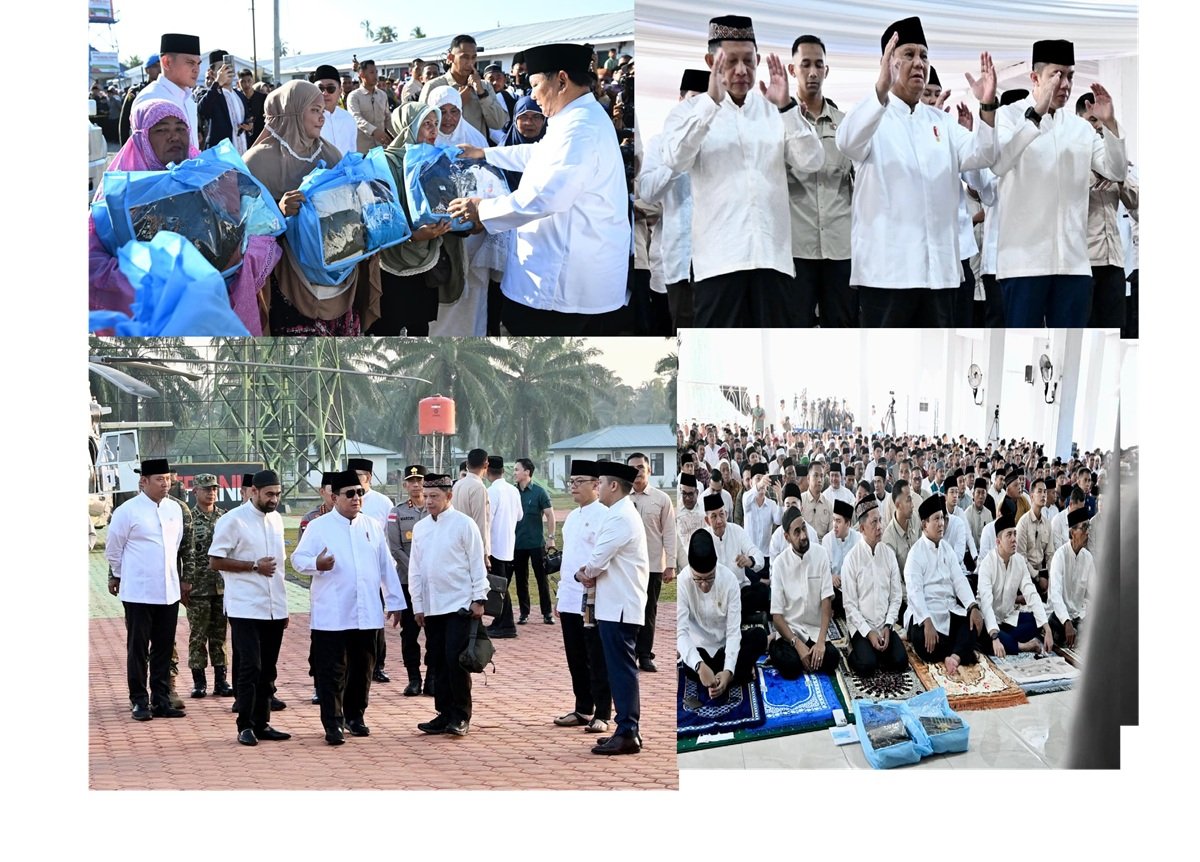
The success of domestic governance appears to have informed the President’s decision to celebrate Idul Fitri in Aceh, a region known for its deep historical and spiritual significance. Far from being a ceremonial gesture, the visit can be interpreted as a form of “inner diplomacy.”
By choosing Aceh, the President sends a domestic geopolitical message: Indonesia’s social cohesion remains intact despite global instability.
The province serves as an epicenter of unity, where diverse spiritual and historical identities converge to strengthen national solidarity.
The visit reflects an understanding that true national defense does not rely solely on military strength, but also on what may be described as “communication sovereignty”—the ability to maintain unity in perception, narrative, and purpose among citizens.
Being present among the people of Aceh on such a significant day bridges the gap between central policy and regional realities, reducing feelings of alienation and reinforcing a shared national vision.
At the same time, the visit signals to the international community that Indonesia remains stable, even as parts of the Middle East face conflict, sections of Europe experience tension, and strategic waterways such as the Strait of Hormuz grow increasingly volatile.
Through a human-centered approach, Indonesia offers a tangible response to global doubts about its national solidity.
Countering Narrative Manipulation
The stability reflected in both the mudik flow and the Aceh visit stands as a counterpoint to attempts at destabilization. As noted by Robert Kaplan in The Revenge of Geography, strategically positioned nations often become targets of systematic psychological operations.
In today’s context, such operations rarely involve conventional weapons. Instead, they take the form of digital information manipulation—framed through issues such as democracy, environmental concerns, and human rights—to weaken domestic sovereignty.
The Prabowo administration has faced pressures ranging from public demonstrations to rhetorical attacks by civil society groups, as well as criticism of strategic programs such as free nutritious meals, village cooperatives, food estate development, and public education initiatives.
These programs have often been reframed into narratives of resistance against authority, with the apparent aim of fostering public distrust and slowing Indonesia’s economic self-reliance.
Even Indonesia’s participation in international peace initiatives has not been immune to delegitimization efforts.
Yet, Idul Fitri 2026 suggests a different reality: a public increasingly capable of filtering information. A form of inner sovereignty has taken shape—enabling citizens to distinguish between constructive criticism and narratives driven by hidden agendas.
Transparent legal processes and tangible progress in pro-people programs have provided a strong rebuttal to skeptics. Indonesia is not a breeding ground for ideological conflict, but rather a space where critical reasoning can thrive without succumbing to digital intimidation.
The alignment between physical achievements—such as the orderly mudik—and the strengthening of collective inner awareness demonstrates that global narrative pressures have limited impact when confronted with lived experience and informed public consciousness.
Inner Order and Social Sovereignty
Ultimately, the strength of a nation lies in the inner calm of its people. As the philosopher Jalaluddin Rumi suggested, true power emerges when individuals master their inner realm.
Idul Fitri offers a moment for the nation to reclaim its intellectual and emotional sovereignty from the noise of disinformation and divisive narratives.
When the public’s inner clarity is maintained, hatred finds no fertile ground—regardless of the intensity of external pressures, including those carried under the banner of civil movements with potential foreign affiliations.
Scholar Seyyed Hossein Nasr has argued that social order reflects inner order. The purity of individual consciousness becomes a prerequisite for sustainable collective peace. Without strong spiritual foundations, societies are more vulnerable to divisive ideologies.
Today’s unity between leadership and citizens reflects a shared inner perspective—one that sees diversity as a blessing rather than a fault line. Strong leadership ensures that policies, from managing mass mobility to making geopolitical decisions, are accountable both materially and morally.
Indonesia’s national stability—from smooth transportation flows to stable food supplies—demonstrates a synchronization between data-driven governance and the spiritual confidence of its people.
In this sense, strengthening national unity becomes a form of the highest “social worship,” carried out by firm leadership and a society that is both intellectually and spiritually aware.
The question remains: will this inner sovereignty become a lasting foundation for a more dignified Indonesia?
The answer depends on how consistently both external governance and internal resilience are nurtured—so that together, they form a new source of strength respected on the global stage.