IndonesianTalk.com — West Papua Police Official Urges Risk-Based Mining Governance
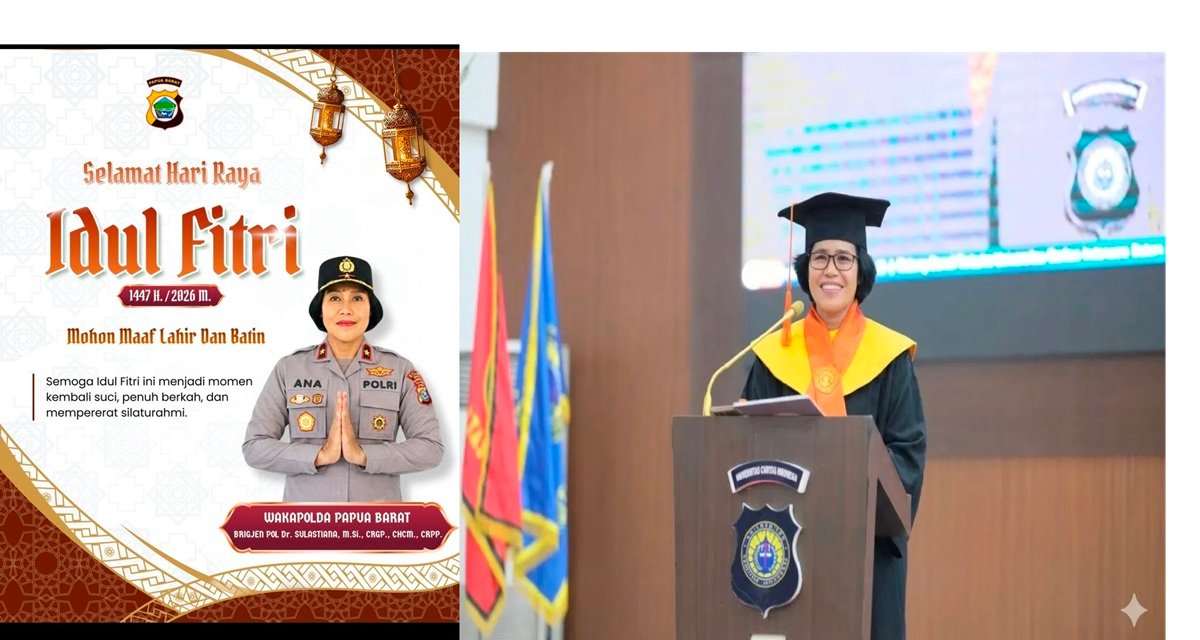
Manokwari — West Papua Police Deputy Chief Brig. Gen. Dr. Sulastiana has called on regional administrations to adopt five principles of risk-based mining governance, arguing that a new policy framework is essential to ensure sustainable and accountable natural resource management.
Speaking during a scientific oration at the inaugural graduation ceremony of Universitas Caritas Indonesia in Manokwari on Saturday, Sulastiana said the approach would help local governments manage natural resources more prudently, transparently and responsibly.
“It is time to reorganize natural resource development with a new paradigm — one that does not place permits ahead of dialogue or prioritize production over protection,” she said.
Sulastiana outlined five key principles. First, regional governments must strengthen policies that recognize and protect indigenous peoples and their customary territories as the foundation of development governance.
Second, the principle of free, prior and informed consent (FPIC) should be treated as a substantive procedure in all mining activities that intersect with customary law areas.
Third, she emphasized the need for joint oversight mechanisms involving the government, indigenous communities, higher education institutions, religious organizations and other independent actors to ensure social accountability in resource management.
Fourth, benefit-sharing must be tangible, encompassing employment opportunities, education, local business empowerment, protection for indigenous women and social investment aligned with community needs.
Fifth, mining operations must adhere to environmental sustainability principles, as ecological damage often leads to long-term social consequences borne by future generations.
“Many mining-related issues in West Papua require a shift in governance paradigm. These five principles are part of that proposal,” she said.
Sulastiana noted that governance challenges in gold mining differ from those in the oil and gas sector, but stressed that both require solutions grounded in risk identification and mapping.
Such measures include designating ecologically vulnerable areas as off-limits to mining, strengthening oversight of illegal mining activities and ensuring the meaningful involvement of indigenous communities.
“Indigenous peoples must be involved from the earliest stages of planning and decision-making in any mining activity,” she added.
According to Sulastiana, the oration — which focused on policy analysis of risk-based mining governance — aimed to raise awareness and encourage participation among newly graduated students, equipping them to bridge knowledge, ethics and social service.
She also underscored the critical role of young people in mitigating environmental risks and preserving natural ecosystems amid extractive activities that fail to meet sustainability standards.
“Young people have broad access. They can directly engage in oversight or become part of policy formulation,” she said.
source: https://matranews.id/wakapolda-papua-barat-brigjen-dr-sulastiana-lima-prinsip-tata-kelola-pertambangan-di-papua-barat/