IndonesianTalk.com — MPR Prepares to Elect Gibran’s Successor as Vice President, Yusril Says Final Decision Rests with Prabowo
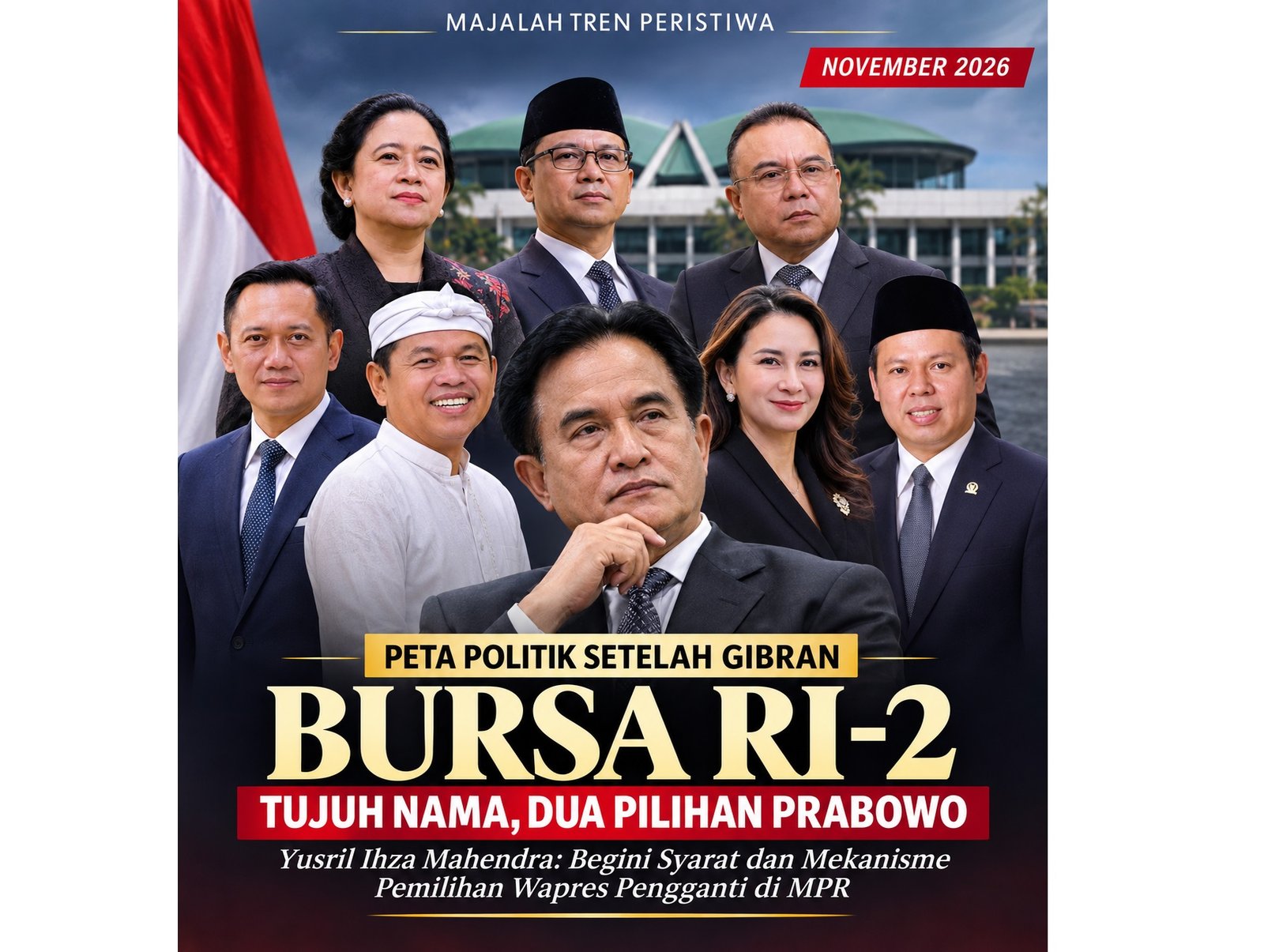
Indonesia’s People’s Consultative Assembly (MPR) has begun preparations to fill the vacant position of vice president, with President Prabowo Subianto holding the constitutional authority to nominate two candidates for the legislature’s consideration, Coordinating Minister for Law, Human Rights, Immigration and Corrections Yusril Ihza Mahendra has said.
The MPR leadership is scheduled to hold a joint meeting with its supporting bodies on Friday, November 13, to discuss preparations for a plenary session on the election of a replacement for Vice President Gibran Rakabuming Raka.
The meeting is scheduled for 2 p.m. at the Delegation Room, Nusantara V Building, within the parliamentary complex in Jakarta.
The preparations follow political and constitutional developments surrounding Gibran’s reported resignation from office, raising questions about the succession process and the political considerations that may shape the selection of his replacement.
Speaking at the Presidential Palace complex in Jakarta on Thursday, Yusril said the authority to nominate candidates rested entirely with the president.
He said Prabowo was free to consider various figures and consult relevant parties before submitting two names to the MPR.
“There is actually no explicit prohibition. It is a matter for the President to consider,” Yusril said when asked whether the replacement vice president could come from outside the political parties supporting the Prabowo-Gibran coalition in the 2024 presidential election.
Prabowo holds the key to nominations
Yusril emphasized that the nomination process was not the prerogative of political parties or other institutions, but a constitutional responsibility vested in the president.
While Prabowo could seek advice and consult various stakeholders, the final decision on the two candidates to be submitted to the MPR would remain his.
“I understand that the normal implementation mechanism is as I have explained, and it is also stipulated in the MD3 Law. But ultimately, we leave everything to the President’s wisdom in making decisions. He will, of course, consider legal perspectives on how the process should be carried out,” Yusril said.
His remarks leave open the possibility that Prabowo could consider candidates beyond the political parties that backed his presidential ticket in 2024.
Yusril acknowledged that Law No. 17/2014 on the MPR, House of Representatives (DPR), Regional Representatives Council (DPD) and Regional Legislative Councils (DPRD), commonly known as the MD3 Law, provides a legal framework for filling the vacancy.
However, he pointed to no explicit provision that categorically excludes candidates from outside the governing coalition.
The political background of potential candidates could therefore become an important consideration as Prabowo weighs his options.
Constitutional deadlines in focus
The procedure for filling a vice presidential vacancy is stipulated in Article 8, paragraph 2, of the 1945 Constitution.
Under the provision, if the vice presidency becomes vacant, the president must submit two candidates to the MPR, which then elects one of them in a plenary session. The assembly is required to hold the election no later than 60 days after the vacancy occurs.
Further provisions are set out in the MD3 Law, including Article 46, which regulates the process of filling the vacant position.
Under the mechanism, the president has a maximum of 14 days to submit two candidates to the MPR. The assembly then exercises its constitutional authority to elect one of the nominees.
The process is therefore not merely a political decision. It must also comply with the procedures and deadlines established by the Constitution and relevant legislation.
A test of political consolidation and constitutional governance
The MPR’s planned joint meeting on Friday signals that the institution is preparing for its role in managing the constitutional succession process.
Public attention, however, is likely to extend beyond the identity of the next vice president. The nomination process, the legal basis for candidacy and the relationship between the presidency and supporting political parties will all shape the next phase of political developments.
On one hand, the president has the constitutional authority to submit two nominees. On the other, the MPR is responsible for electing one of them through a plenary session.
Both institutions must exercise their respective powers within the constitutional framework.
The replacement of the vice president is thus more than a change of personnel within the administration. It represents a test of Indonesia’s commitment to legal certainty, political legitimacy and continuity of government.
Friday’s joint meeting is expected to mark an important early step in determining how the constitutional process will unfold.