Poland and Indonesia Explore AI Education Partnership to Prepare Future-Ready Generation
Innovation forum highlights digital skills, critical thinking and human-centred AI education as Indonesia faces a shortage of nine million digital talents by 2030.
As artificial intelligence (AI) rapidly transforms education, business and industry, Indonesia and Poland are seeking to strengthen cooperation in educational technology and digital skills development to prepare a workforce capable of competing in an increasingly technology-driven global economy.
The agenda took centre stage at the 2nd Poland–Indonesia Innovation Forum: EdTech & AI, held at the Indonesian Chamber of Commerce and Industry (KADIN) building in South Jakarta on Tuesday, Nov. 10, 2026.
Under the theme “Connecting Poland and Indonesia for the AI-Ready Generation,” the forum brought together Polish education technology innovators, Indonesian educational institutions, industry representatives, school leaders and policymakers.
Organised by the Polish Investment and Trade Agency (PAIH), the Embassy of the Republic of Poland in Jakarta and KADIN Indonesia, the event formed part of Poland Festival 2026, providing a platform to exchange expertise and explore practical partnerships in technology-driven education.
The urgency of the discussion reflects Indonesia’s growing adoption of AI. According to figures presented by the organisers, AI penetration and usage in the country’s education sector have exceeded 60 percent, while approximately 95 percent of university students reportedly use generative AI to support their studies.
Yet widespread adoption does not necessarily translate into adequate digital readiness.
Indonesia is estimated to need around nine million skilled digital talents by 2030, highlighting the need to strengthen digital literacy, teacher competencies, technological infrastructure and education curricula.
Education as the Foundation of Competitiveness
Polish Ambassador to Indonesia Barbara Szymanowska said AI was fundamentally changing almost every sector of modern life, extending far beyond technology companies into classrooms, workplaces and business operations.
She argued that simply knowing how to operate AI tools was no longer sufficient. People needed to understand how the technology worked, its potential applications and the risks associated with its use.
“AI is changing the entire world. Its development is not limited to one country. This technology touches almost every aspect of life, from learning in schools to business activities,” Barbara said.
Drawing on Poland’s economic transformation over the past three decades, she highlighted the importance of human capital, particularly mathematics, science and critical thinking, in building national competitiveness.
She said education should go beyond transferring knowledge and technical skills. The ability to ask questions, analyse problems and develop new understanding would become increasingly valuable as AI made information readily available.
“I believe education must strengthen critical thinking and the ability to ask questions. Good questions can open discussions and generate new understanding. That is how research and innovation develop,” she said.
Her remarks underscored the importance of investing in education as a long-term strategy for economic development, ensuring that countries become contributors to the global innovation ecosystem rather than merely consumers of imported technologies.
Coding Education Beyond Programming
The integration of coding and AI into Indonesian schools was another major topic at the forum.
General Manager of Koding Next Indonesia Abdallah Sadurdeen Khan argued that the success of technology education should not be measured solely by students’ ability to operate digital devices, write computer code or develop applications.
Instead, coding education should cultivate critical thinking, problem-solving, adaptability and collaboration.
These competencies, he said, would remain relevant across professional sectors, including occupations that had little direct connection to the technology industry.
However, Indonesia still faces significant obstacles in implementing coding and AI education.
Teacher readiness remains a major concern, as technology training does not automatically equip educators with the confidence and pedagogical skills required to teach these subjects effectively.
Implementation also varies between schools, partly because the programmes are not yet mandatory across the education system.
Infrastructure presents another challenge. Khan said approximately 23 percent of schools remained without internet access, while around 3,000 schools faced electricity supply limitations.
These disparities risk widening the digital education gap between urban and remote communities.
He emphasised that strengthening fundamental education should come before introducing students to more advanced AI concepts. Basic literacy, mathematics, creativity and computational thinking are essential foundations.
Khan illustrated the potential of practical learning by presenting an example of an elementary school student who developed an application to identify air quality.
Through the project, the student learned to process data, use AI models, test an application, identify errors and improve the results.
Such an approach demonstrates how technology education can encourage creativity and problem-solving rather than simply producing students who consume digital products.
Keeping Humans in Control of AI
Beyond the opportunities offered by AI, the forum also addressed a fundamental question: how can society ensure that humans remain in control of the technology they create?
Chairman of the Indonesia AI Association Dian Martin explored the issue in a presentation titled “From AI Literacy to Holistic Competence: Building Indonesia’s AI-Ready Human Capital.”
Martin argued that AI readiness must be understood in broader terms than the ability to operate applications or generate AI-based content.
It should also encompass an understanding of how the technology affects organisations, society, human behaviour and decision-making processes.
He distinguished between personal AI usage and its implementation in corporate environments. In business, for example, greater efficiency and time savings do not automatically translate into higher productivity.
Companies need to assess how the time saved through AI can be reinvested to generate additional value. Without proper measurement, technology adoption risks changing working methods without delivering meaningful improvements in performance.
Martin also warned about the potential emotional dependence on AI, particularly when users treat chatbots as personal companions and place excessive trust in their responses, including inaccurate information.
Another concern is the emergence of echo chambers, in which AI may reinforce existing beliefs and opinions rather than encourage users to critically examine the information they receive.
He therefore promoted the principle “Stay Human, Stay in Charge”, emphasising that human judgement, accountability and ethical responsibility must remain central to AI adoption.
AI literacy, he said, should include an understanding of technological limitations, ethical considerations and the ability to evaluate information critically.
Ultimately, the future of education should not be measured by how sophisticated its technology becomes, but by how effectively that technology enhances human capabilities without undermining creativity, critical thinking and social responsibility.
Expanding Indonesia–Poland Cooperation
The forum also highlighted opportunities to deepen bilateral cooperation in educational technology and AI.
Barbara said educational relations between Indonesia and Poland had developed through student exchanges, education programmes and partnerships involving businesses and institutions.
Several Polish learning platforms have already been introduced in Indonesian schools. Koding Next’s curriculum was cited as an example of the transfer of educational expertise and experience from Poland to Indonesia.
However, Barbara stressed that cooperation should extend beyond discussions and networking events to include concrete business partnerships, investment and mutually beneficial projects.
The event continued with a panel discussion on opportunities for Poland–Indonesia cooperation in implementing EdTech and AI in schools.
Moderated by Jacek Kolomyjec of PAIH, the panel featured Mateusz Rybiński, president of the EdTech Poland Foundation; Laurence Smith, head of transformation at Global Transformation Partners; and Syahraki Syahir, CEO of Veda Praxis.
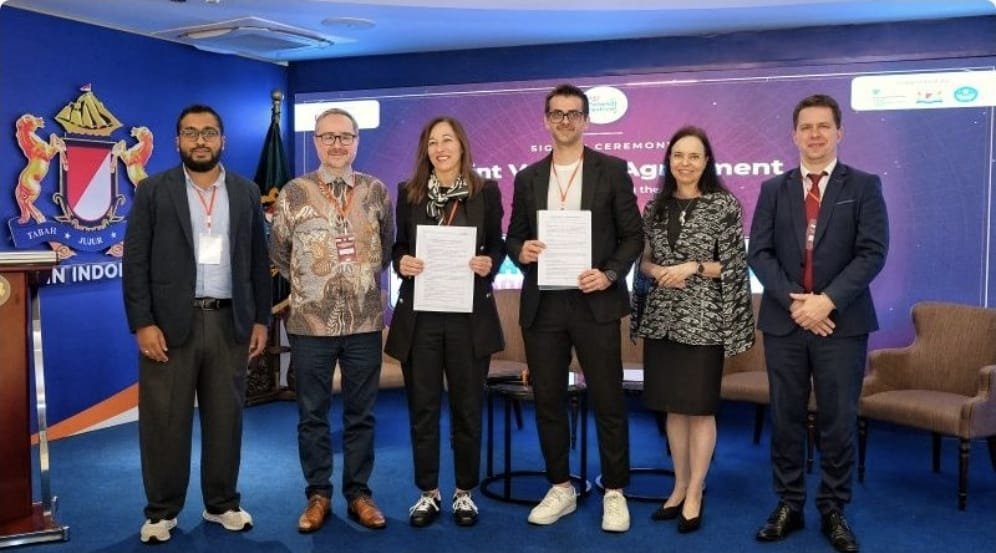
The programme also included the signing of memorandums of understanding, exhibitions of Polish educational technology solutions and business networking sessions.
School principals and teachers were given opportunities to showcase best practices and AI projects developed within their respective educational institutions.
The organisers expect these activities to connect the needs of Indonesian educational institutions with the expertise and innovative solutions offered by Polish EdTech companies.
Potential areas of cooperation include digital learning solutions, teacher training and capacity-building programmes for students and educators.
Investing in Human Capital for the AI Era
The 2nd Poland–Indonesia Innovation Forum demonstrated that cooperation in education and technology increasingly carries strategic economic and business significance.
For Indonesia, the challenge is not simply to accelerate AI adoption, but to ensure that the technology improves educational quality, workforce productivity and national competitiveness.
For Poland, meanwhile, collaboration offers opportunities to expand its EdTech presence while strengthening economic ties with one of Southeast Asia’s largest markets.
The forum was part of Poland Festival 2026, a month-long promotional programme taking place throughout November in Jakarta, South Tangerang, Surabaya, Bali and Kupang.
Now in its seventh edition, the festival features activities spanning trade, education, digital technology and consumer products.
More than a promotional platform, the programme reflects broader efforts to strengthen economic and business relations between Indonesia and Poland through cross-sector partnerships.
Ultimately, success in the AI era will depend not only on technological sophistication or the scale of digital investment, but also on the quality of the people who develop, manage and use these technologies responsibly.
As machines and algorithms become increasingly capable, human knowledge, creativity, integrity and critical thinking will remain among the most valuable assets in determining a nation’s future.