IndonesianTalk.com — When PR Professionals Stop Asking AI—and Start Talking to It
The conversation at a recent gathering hosted by the Perhimpunan Hubungan Masyarakat Indonesia (Perhumas) hinted at a quiet but profound shift. Artificial Intelligence (AI) is no longer seen merely as a tool. It is becoming a thinking partner.
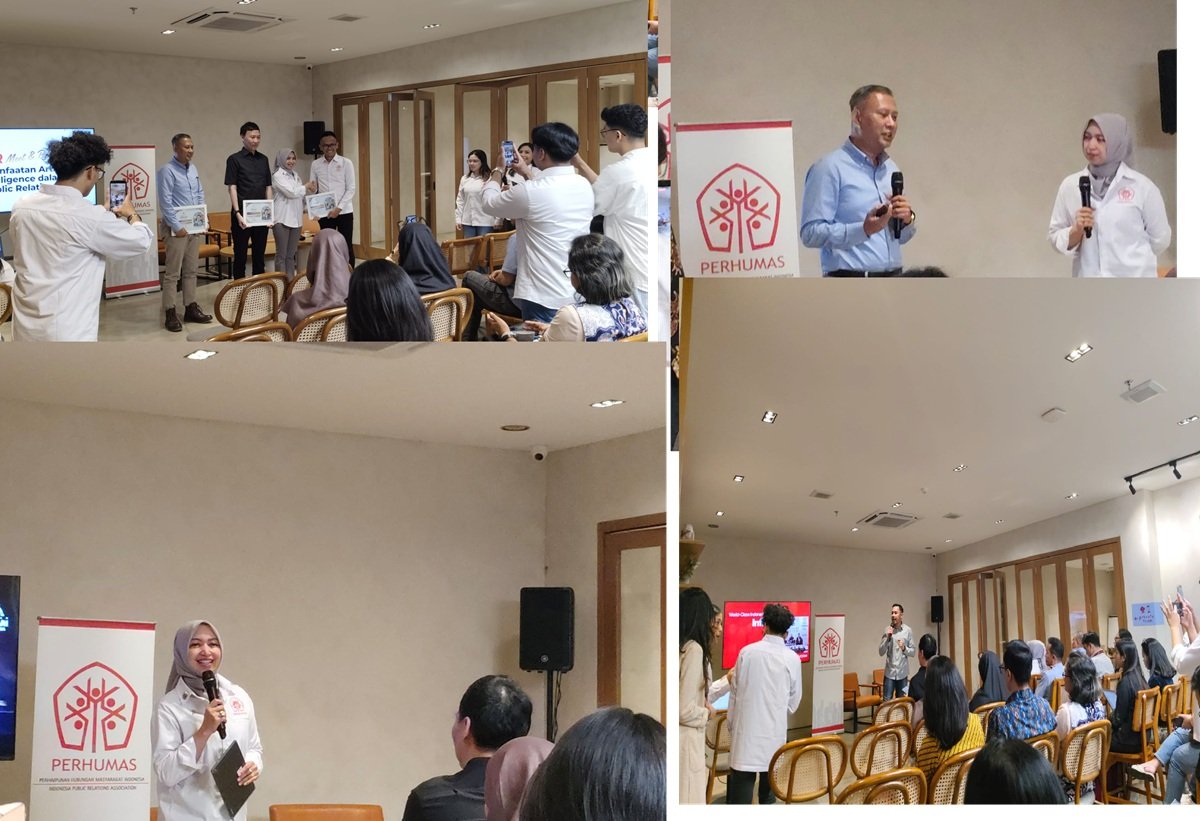
Held at Other Half Cafe on Friday afternoon, April 24, 2026, the PR Meet and Brew forum unfolded as more than a casual networking session. For two hours, practitioners from across sectors—seasoned public relations veterans and younger professionals alike—engaged in a dense, evolving discussion about the future of their craft.
What emerged was not anxiety alone, but a reframing. Increasingly, professionals are no longer “asking” AI for answers. They are “discussing” with it—using it as a brainstorming partner that can follow, and sometimes anticipate, the direction of human thought.
Dudy Rudianto, founder of Evello Big Data Analytics, offered a historical lens. Long before today’s sophisticated systems, he had experimented with early forms of AI and digital analytics. In 2012, drawing from online conversations—including YouTube—he helped shape communication strategies that could shift public sentiment.
“At that time, the tools were still basic,” he recalled. “But data already allowed us to go deeper.” What was once experimental has now become foundational.
Yet the transformation is not only technological. It is cognitive. AI is increasingly functioning as an extension of human thinking—absorbing technical complexity and freeing professionals to focus on broader strategy. The more people interact with AI, the more they seem to rediscover distinctly human qualities: empathy, intuition and unpredictable creativity.
Yoris Sebastian, a member of Perhumas’ advisory board and founder of OMG Consulting, framed it as a complementary relationship. AI, he argued, does not replace human intuition; it amplifies it.
“It accelerates the process, but direction still comes from humans,” he said, pointing to the creative industries, including film, where technology can assist without displacing the essence of storytelling. The real risk, he added, lies in refusing to engage with AI at all.
Moderated by Dian Agustine Nuriman, Perhumas’ vice chairperson, the discussion moved fluidly between practical insights and broader reflection. A shared realization began to surface: the role of public relations professionals is being redefined.
Today, communication expertise alone is no longer sufficient. Practitioners are expected to understand data, interpret algorithms and recognize patterns in digital behavior. AI is no longer external to the workflow—it is embedded within it.
For some, it has even begun to feel like a kind of “mental chip”: enhancing the ability to see further, decide faster and create more expansively. The metaphor may sound exaggerated, but in practice, it is increasingly tangible.
The PR Meet and Brew forum thus became more than a discussion space. It was a marker of transition. Amid coffee cups and layered conversations, one conclusion stood out: the future of public relations is not about competing with AI.
It is about learning how to think alongside it.

- Open the Gojek app and choose GoPay Transfer.
- Enter the number 0816-1945-288 and the amount shown above.
- Add your name as a note (optional) and complete the transfer.