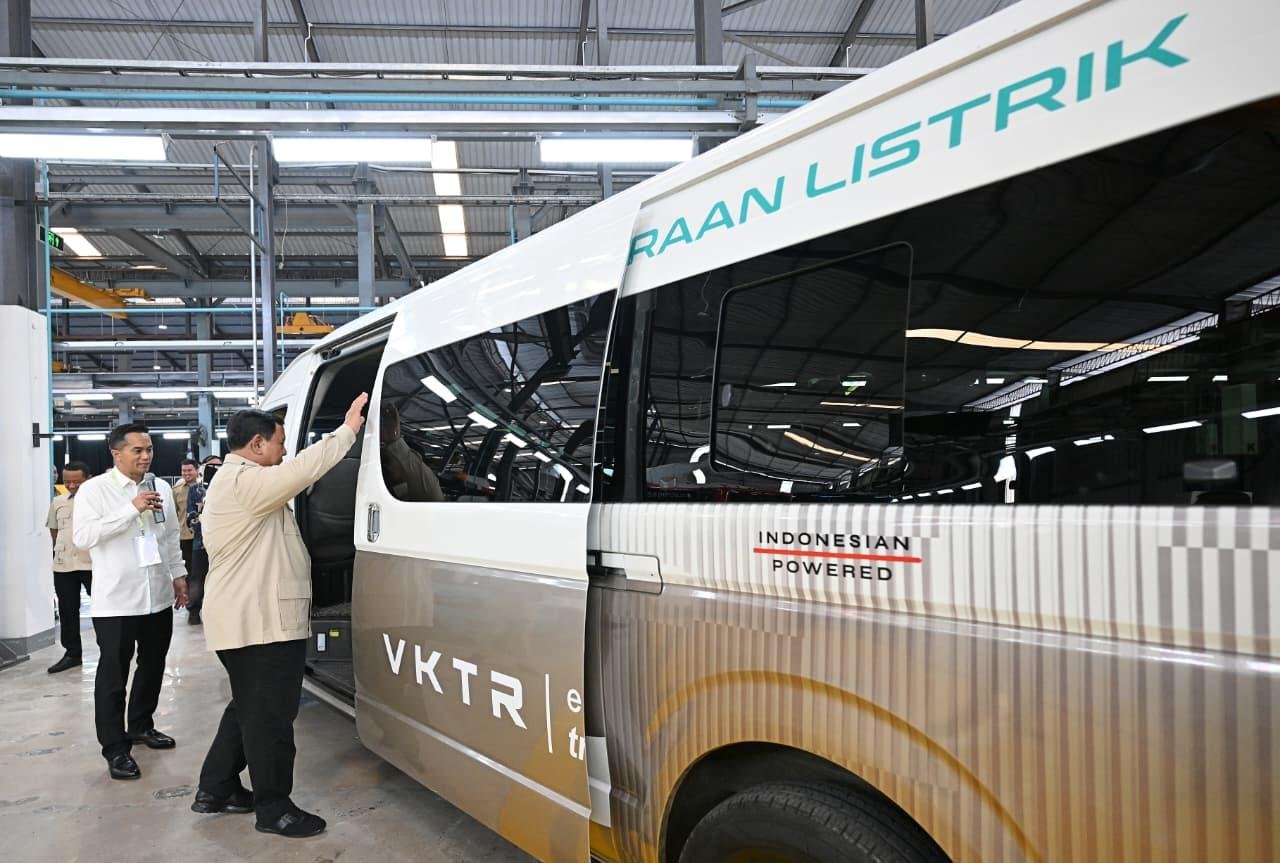
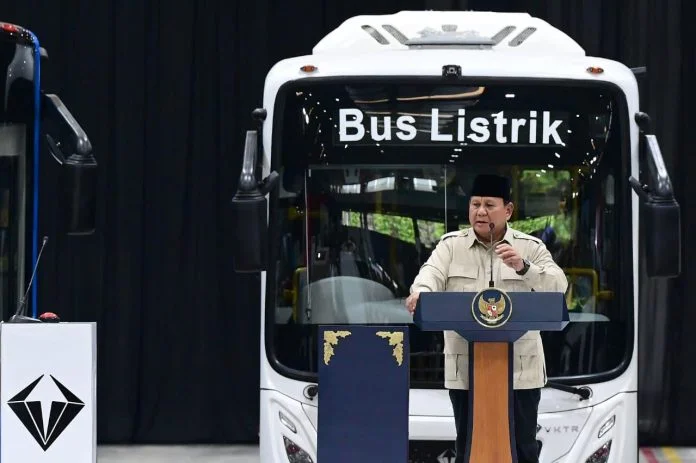
IndonesianTalk.com –– Magelang, Central Java – President Prabowo Subianto has set an ambitious tone for Indonesia’s industrial future, declaring that the country must build its own “national champion” in the automotive sector—starting from the inauguration of an electric vehicle assembly plant in Magelang.
Speaking at the launch of PT VKTR Sakti Industries, Prabowo emphasized that a large nation like Indonesia cannot remain merely a market destination. Industrialization, he said, is a critical phase in achieving technological sovereignty and national resilience.
“Innovation must not stop at theory and experimentation. It must be transformed into real industrial production,” he said, underlining the government’s commitment to clean technology-based manufacturing as a cornerstone of Indonesia’s economic strategy.
Industry and Energy Independence
Prabowo framed industrialization as the final stage of technological advancement. The presence of a domestic electric vehicle (EV) industry, he argued, reflects Indonesia’s determination to strengthen its industrial structure while reducing dependence on imported components.
The commercial automotive sector—long considered the backbone of national logistics—holds strategic importance. Transitioning from fossil fuels to electricity, he noted, would not only modernize transportation but also improve Indonesia’s trade balance.
The President also highlighted the strong linkage between industrial development and energy as well as food security. Fuel subsidies, which have long burdened the state budget, could be redirected toward productive sectors. Locally produced electric vehicles, in this context, offer a pathway to reduce vulnerability to volatile global oil prices driven by geopolitical tensions.
With transportation accounting for a significant share of national energy consumption, the establishment of local assembly facilities in Central Java is expected to shorten supply chains and enhance logistical efficiency. Lower logistics costs, in turn, could help stabilize food prices and consumer goods.
Prabowo’s vision goes beyond industrial growth. He wants Indonesia to produce a “national champion” in the automotive industry—akin to what Japan and South Korea have achieved.
Such a status, he stressed, is not merely about building a strong brand. It represents industrial sovereignty and national pride on the global stage.
He expressed high expectations for VKTR to fill this gap, with a bold target: within the next few years, Indonesian brands should be able to compete alongside global players.
For the domestic private sector, this ambition presents both a challenge and an opportunity. It requires robust management systems, sustained innovation, and the courage to invest in the EV sector—not as a short-term venture, but as a long-term technological commitment.
Downstreaming and Economic Transformation
The EV industry also serves as tangible proof of Indonesia’s downstreaming policy, a key agenda consistently championed by the government. Rather than exporting raw materials, Indonesia is increasingly processing them into higher-value products.
Nickel, once exported in raw form, is now being developed into batteries for electric vehicles—signaling a shift toward an integrated industrial ecosystem.
This transformation marks Indonesia’s transition from a commodity-based economy to a manufacturing-driven one. The government’s focus is to ensure that domestic industries grow exponentially, creating skilled jobs, facilitating technology transfer, and strengthening the national tax base.
Prabowo also sent a clear message to his cabinet: the state must uphold legal certainty and eliminate bureaucratic obstacles for industries that demonstrably add value to the domestic economy. Downstreaming, he stressed, is non-negotiable in safeguarding economic sovereignty.
The establishment of the EV industry in Magelang is expected to stimulate regional economic growth. The automotive sector’s multiplier effect is significant, with small and medium enterprises likely to emerge within the surrounding industrial ecosystem.
This aligns with the government’s broader strategy to decentralize economic growth, reducing over-reliance on Jakarta.
Job creation will extend beyond manual labor to include skilled technical positions, providing opportunities for Indonesia’s young workforce to apply their expertise domestically. As Prabowo noted, “the rise of industry is the rise of our workers’ dignity.”
Building a Resilient Economic Fortress
Amid global uncertainty and looming energy crises, Indonesia’s strategy to strengthen its domestic foundation appears increasingly relevant. The EV industry is envisioned as one of the pillars of this economic resilience.
By shifting to electricity and utilizing domestic resources, Indonesia can build a natural buffer against external pressures. Strategic policies are being put in place to ensure readiness for future energy disruptions.
Magelang, therefore, may well be remembered as a turning point—a moment when Indonesia chose to move beyond being a passive market and began asserting itself as a key global producer.
The direction is clear: development anchored on three pillars—downstreaming, innovation, and self-reliance.
The challenge now lies in execution. As Prabowo has set the compass, it is up to the cabinet and industry players to follow through decisively, ensuring that Indonesia’s economic sovereignty is not just an aspiration, but a reality.