Indonesiantalk.com — Orchestrating Humanitarian Diplomacy on the Global Stage
The strike of a gavel at the United Nations headquarters in Geneva earlier this January did more than conclude a ceremonial procedure. It marked a moment of global recognition of Indonesia’s growing role in the struggle for human rights and justice.
For the first time since the UN Human Rights Council (UNHRC) was established, Indonesia has been formally entrusted with the presidency of the Council — a remarkable development unfolding amid a world marked by geopolitical turbulence and moral uncertainty.
The appointment sends a clear message from Geneva to Jakarta: in the complex arena of international politics and law, Indonesia is no longer merely a participant, but an emerging conductor in the orchestra of global moral leadership.
The election of Ambassador Sidharto Reza Suryodipuro as President of the UN Human Rights Council for 2026 was far from accidental.
It represents the culmination of what might be described as President Prabowo Subianto’s “precision diplomacy” — a carefully calibrated foreign policy that blends firmness with inclusivity.
Since assuming office, President Prabowo has consistently articulated proposals for global peace through a diplomatic style that is assertive yet accommodating.
National interests are framed not in narrow terms, but within a broader humanitarian vision that resonates beyond borders.
An Eastern Touch
Today’s international system resembles a dense jungle of competing narratives and double standards. Major powers often invoke sovereignty selectively, defending it when convenient and overlooking injustice elsewhere.
Indonesia, under Prabowo’s leadership, has chosen a different posture. As a leader shaped by Eastern political sensibilities, Prabowo understands that prestige — moral as much as material — remains the most valuable currency in international relations.
Indonesia’s overwhelming support in the UNHRC election, securing 186 votes out of 192 member states, followed by its acclamation by the Asia-Pacific Group in December 2025, illustrates the effectiveness of this diplomatic approach.
It is a reminder that quiet persistence, trust-building and moral consistency can still yield tangible results.
Jakarta has succeeded in convincing the world that Indonesia is a stable, democratic nation committed to the rule of law — without positioning itself as a follower of either Western or Eastern power blocs.
A Confident Indonesia
This achievement recalls the thinking of the late Benedict Anderson, the renowned Cornell University scholar who devoted much of his life to studying Indonesia.
In Imagined Communities, Anderson explored how national identities are constructed through shared narratives and historical experience.
Were Anderson alive today, he might argue that Indonesia is forging a new identity: that of a moral leader of the Global South. Indonesia’s diplomatic narrative remains rooted in its own history — a nation born out of resistance to colonial oppression.
In Geneva, Indonesia does not speak about human rights with the didactic tone often associated with Western liberalism. Instead, it speaks the language of solidarity, informed by the lived experience of colonization.
This approach offers an implicit critique of the double standards that continue to undermine global justice.
The Moral Heart
The UN Human Rights Council is often described as the moral heart of the international system. Yet that heart is currently suffering from arrhythmia.
The shift from a rule-based international order toward a more transactional one has weakened collective responses to humanitarian crises.
The paralysis caused by veto politics in the UN Security Council has repeatedly stalled meaningful intervention, most visibly in the ongoing tragedy in Palestine. It is in this context that Indonesia’s presidency becomes particularly significant.
As president of the UNHRC, Indonesia now holds the gavel that shapes global agendas. Its voice on Palestine, the protection of migrant workers and the right to health will carry greater weight.
President Prabowo has made clear that human rights are not merely domestic obligations, but erga omnes principles — duties owed to all humanity, without exception.
Digital Authoritarianism and Climate Crisis
The most pressing challenges today are no longer limited to traditional human rights violations. Emerging threats include digital authoritarianism driven by artificial intelligence, and the climate crisis, which acts as a threat multiplier for basic human rights.
As an archipelagic nation highly vulnerable to climate change, Indonesia is uniquely positioned to champion ecological justice within the Human Rights Council.
It possesses the moral standing to call on industrialized nations in the Global North to acknowledge and repair the environmental damage that disproportionately affects societies in the Global South.
This moment also offers an opportunity to advance new international legal frameworks governing the conduct of major technology corporations, ensuring that digital innovation strengthens democracy rather than erodes human dignity.
An Investment in Trust
For Jakarta, the diplomatic success in Geneva represents more than symbolic capital. It strengthens Indonesia’s credibility as a human rights leader, reinforcing investor confidence and strategic partnerships.
It sends a signal that under Prabowo’s leadership, Indonesia is a safe harbor for the rule of law and the protection of human dignity.
The message from Geneva is unmistakable: Indonesia has moved beyond merely “participating in the international order” to helping define its character.
This is a victory for humanitarian diplomacy — proof that human dignity can and should stand above short-term economic interests.
The world may appear increasingly dark, but through its leadership of the UN Human Rights Council, Indonesia has lit a candle of hope.
The sound of the gavel in Geneva now carries a mandate for Jakarta: to ensure that international law does not remain a tool of coercion, but becomes a living instrument for protecting the world’s most vulnerable.
Echoes of Humanity
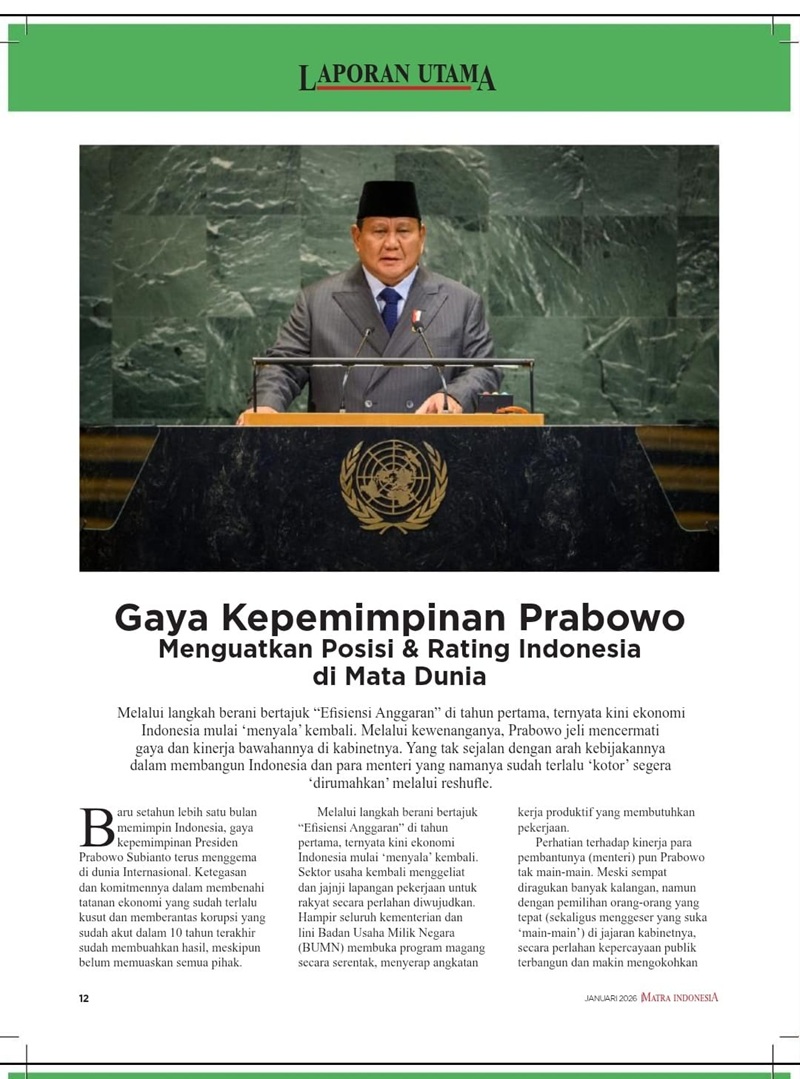
In his inaugural address to the 80th UN General Assembly last September, President Prabowo employed a powerful metaphor drawn from Indonesia’s own history of injustice:
“Our nation knows that pain. For centuries, the Indonesian people lived under colonial domination, oppression and enslavement. We were treated as lesser than dogs on our own land.”
That message has clearly resonated. It affirms that Indonesia understands the suffering of nations still trapped in cycles of oppression, including Palestine — because Indonesia itself was born from the same historical crucible.
- #Dr. Eko Wahyuanto
https://ebooks.gramedia.com/id/majalah/matra-indonesia/jan-2026