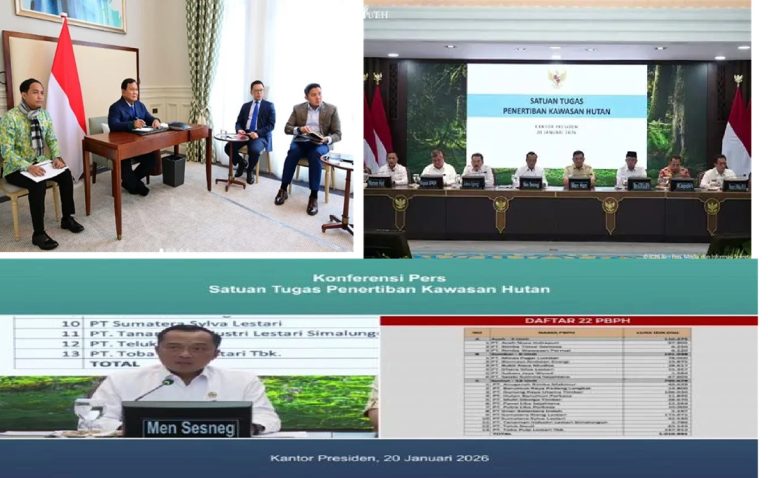
Indonesiantalk.com –– President Prabowo Subianto has once again reaffirmed his instruction to Forestry Minister Raja Juli Antoni to complete the revocation of licenses held by 22 forestry concession companies (Perizinan Berusaha Pemanfaatan Hutan/PBPH), covering more than one million hectares of forest land.
The move sounds a death knell for what may be called speculative capitalism in Indonesia’s forestry sector — a practice that has quietly eroded the country’s green backbone for decades.
Too long have Indonesia’s forests been held hostage by so-called free riders: corporate entities that secured state permits but never planted a single tree, let alone managed the land productively.
Constitutional muscle
This phenomenon is widely known as land banking: state-issued licenses treated as speculative assets, inflated on stock markets or used as collateral in banks, while the land itself is left idle, degraded, or illegally encroached upon.
The mass revocation of permits sends an unmistakable message: forests are not speculative commodities. Article 33 of the 1945 Constitution is explicit — land, water and natural resources must be controlled by the state and used for the greatest prosperity of the people.
Indonesia’s decision to withdraw concessions from environmentally destructive companies also rests on solid international legal ground. The principle of Permanent Sovereignty over Natural Resources, enshrined in United Nations General Assembly Resolution 1803 (XVII), affirms every nation’s sovereign right to regulate, manage and reclaim control over its natural resources for national development and public welfare.
When companies fail to uphold their responsibilities — allowing degradation, engaging in malpractice, or triggering deforestation — the state is fully justified in reclaiming that mandate.
The revocation of licenses from free riders is therefore not an arbitrary act, but a corrective measure against decades of entrenched agrarian injustice.
The meaning of green sovereignty
The most striking moment came when the policy was reaffirmed during a limited cabinet meeting (Ratas) held online from London, while President Prabowo was on an official visit.
The location matters. London is one of the world’s green finance hubs. From there, the President sent a clear signal to global markets and international stakeholders: Indonesia is conducting a serious house cleaning of its forestry sector.
This was a moment of “locking in green sovereignty”. The message was firm — Indonesia will not allow its natural wealth to be dictated by short-term interests, whether from global or domestic corporations that disregard environmental responsibility.
Green sovereignty has two dimensions. First, the state retains full authority to redistribute idle or abandoned land to productive and accountable entities — whether through strategic state-owned enterprises such as Danantara or Agrinas for food and energy security, or through social forestry schemes that grant management rights to local communities.
Second, Indonesia refuses to become a mere object of global carbon governance. While setting firm limits on deforestation as part of climate mitigation, the country insists on safeguarding its economic sovereignty, ensuring it is not co-opted by foreign interests operating under the banner of “green” agendas.
From a sociological perspective, the urgency of this policy cannot be overstated. Recurrent floods and ecological disasters across the country stand as grim testimony to the cost of corrupt forest governance.
Lives have been lost, and trillions of rupiah in assets destroyed, because forests have lost their protective function — monopolized by irresponsible corporations that treated land as paper assets rather than living ecosystems.
Revoking permits in critical areas is a first step toward restoring forests’ hydrological functions. Yet green sovereignty will remain incomplete without social justice. If one million hectares merely shift from one large corporation to another, Indonesia risks reproducing an “elite circulation of land control”.
True agrarian justice requires consistent support for agroforestry models that place indigenous peoples and local communities at the center of forest management. In doing so, the state does not merely save trees, but safeguards human lives — especially those who depend directly on forest ecosystems.
Local communities are, in fact, the most effective forest guardians. Their emotional, cultural and economic ties to the land are rooted in intergenerational stewardship, not short-term profit.
This bold and radical step is only the beginning. License revocation represents a form of creative destruction in public policy.
The real challenge lies after revocation. Without strict, technology-based monitoring systems — such as real-time satellite imagery — former concession areas risk becoming new targets for illegal logging syndicates and land grabbers.
Policy integration across institutions is crucial. The Forestry Ministry cannot work alone. Total synchronization is needed with the Environment Ministry, the Agrarian and Spatial Planning Ministry, and law enforcement agencies.
Sectoral ego remains the greatest enemy of green sovereignty.
Coordination must be strengthened to close regulatory loopholes that allow land and forest mafias to operate in the shadows of bureaucracy.
The political will demonstrated through the “London cabinet meeting” has laid the foundation for a new direction in Indonesia’s natural resource governance. It underscores a simple but powerful truth: economy and ecology are not opposing poles, but an integrated whole.
The task now falls to the public, academics, NGOs and all elements of society to guard this process. The one million hectares reclaimed must not fall into the wrong hands again.
This strategic move shows that forest governance is finally being steered toward its rightful goal — sustainable green sovereignty for public welfare.
Green sovereignty is not merely about revoking permits. It is about replanting hope for future generations, ensuring that Indonesia’s forests are never again pawned off to speculators.
#Dr. Eko Wahyuanto is a public policy analyst.